Authentic Assessments: Measuring What Students Can Do

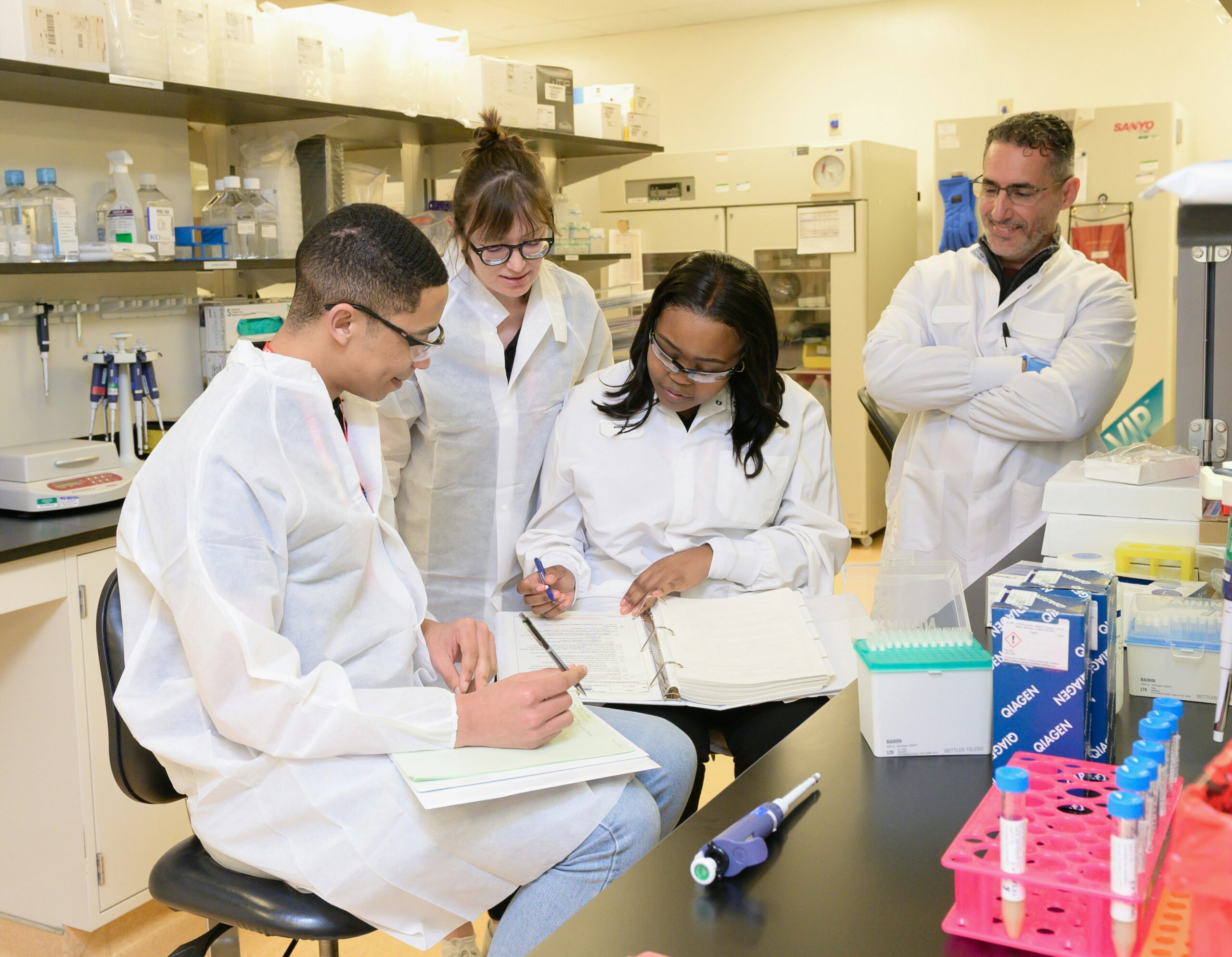
One of the pillars of successful course design is creating assessments that align with clearly stated learning objectives; this alignment provides a clear connection between what students are expected to learn and how their achievement is evaluated. Traditional assessments, such as term papers, quizzes, and exams, typically ask students to demonstrate their knowledge by recalling information or applying concepts in controlled or simulated settings. These strategies can be very effectivetwo students leaning over a table in front of a computer writing on white paper in some contexts. However, when the goal is to challenge students to apply their learning in meaningful, real-world scenarios, authentic assessments may be a better fit. By asking students to put their knowledge and skills into practice, authentic assessments can help students develop and demonstrate abilities that extend beyond the classroom.

When students enter the workforce, they most likely will not be given a multiple-choice test to assess their performance. Instead, they will be evaluated based on their ability to complete tasks, solve problems, and respond appropriately to situations they encounter on the job. Authentic assessments prepare students for these situations by asking them to use higher-order thinking skills, such as analyzing information, developing and evaluating solutions, and making decisions both independently and collaboratively (Vlachopoulos & Makri, 2024). These types of assessments can help bridge the gap between learning in the classroom and what students will be expected to do in professional settings. Because these assessments connect directly to skills students may use in their future careers, they can make learning feel more relevant and purposeful. This connection may increase student engagement by helping students see the practical value of what they are learning.

Some examples of authentic assessments include:

  • Conducting a hands-on experiment
  • Engaging in role play
  • Performing or demonstrating a skill (playing music, delivering a speech, teaching a lesson, etc.)
  • Developing a website or app
  • Examining a case study
  • Creating a business or marketing plan
  • Producing a video or podcast
  • Creating a patient care plan

By requiring students to apply their knowledge in complex, realistic situations, authentic assessments provide instructors with a more complete picture of what students know group of people in a laband can do. Rather than focusing primarily on recall or selecting a correct answer, these assessments allow instructors to observe how students approach problems, justify their decisions, and communicate their ideas. This broader range of skills can help instructors more accurately evaluate student achievement of the learning objectives (Messier, 2022).

Additionally, authentic assessments may help address some of the challenges AI creates for traditional forms of assessment. AI tools are making it increasingly difficult for instructors to determine whether work submitted was actually completed by the student or by generative AI. Authentic assessments value the process in addition to the final answer, product, or solution. Giving students opportunities to explain their answers, reflect on their choices, or revise their work gives instructors additional evidence of learning that is less dependent on a single written response. Although authentic assessments do not eliminate the possibility of AI use, they can provide instructors with more varied and meaningful evidence when evaluating student learning.

Interested in learning more? The University of Illinois Chicago has a guide that can help you get started creating your own authentic assessments.

Do you have any authentic assessments you have used in class that you would like to share? Please add them to the comments section below.

Amy Brusini, Senior Instructional Designer
Center for Teaching Excellence and Innovation
 

Image source: Unsplash

References:

Messier, N. (2022). Authentic assessments. Center for the Advancement of Teaching Excellence at the University of Illinois Chicago. https://teaching.uic.edu/resources/teaching-guides/assessment-grading-practices/authentic-assessments/

Vlachopoulos, D., & Makri, A. (2024). A systematic literature review on authentic assessment in higher education: Best practices for the development of 21st century skills, and policy considerations. Studies in Educational Evaluation, 83, 101425. https://doi.org/10.1016/j.stueduc.2024.101425

Piloting a Well-Being Lab in the Public Health Studies Curriculum

[Guest post by Leslie Bauman, Junior Lecturer in the Department of Psychological and Brain Sciences, Johns Hopkins University]

Introduction
The academic public health community has long recognized the value in experiential learning when it comes to public health practice. Like programs at many other small group of university students in a classroomuniversities, PHS majors at JHU must complete at least 80 hours of field work in a professional public health setting and engage in reflection on how those experiences bring their coursework to life. At the same time, a gap exists in that public health curricula generally do not reflect the importance of experiential learning when it comes to the very concept of health and well-being itself. Enter the Well-Being Lab.

In 2023, we launched an ambitious 2-year pilot of an experiential Well-Being Lab designed to address this curriculum gap. The idea was simple but powerful—what if students not only learned about population health and well-being but experienced it firsthand?

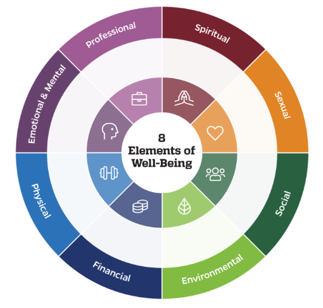
Our goals for the pilot were to test feasibility, gather student input, and explore models for integrating the Lab into the curriculum. During the pilot, students selected from a “menu” of activities and workshops that were available on campus through the PHS program or one of our campus partners (Health Promotion and Well-Being, Life Design Lab, Counseling Center, etc.), participate in the activity, and then reflect on how those experiences connected to their personal health and to broader public health concepts. The activities are categorized into eight aspects of health and well-being established by JHU’s Health Promotion and Well-Being office:

  • Emotional/mental health
  • Physical health
  • Spiritual health
  • Social health
  • Sexual health
  • Environmental health
  • Financial health
  • Professional health

Students were required to complete at least two well-being labs, each addressing a different dimension of well-being.

Results of the Pilot
The results were encouraging. Students engaged deeply with well-being concepts and were able to clearly articulate how their activities connected to population health themes. Many participants reported meaningful gains in stress management skills and increased awareness of campus well-being resources.

Colored wheel representing the eight elements of well-being: spiritual, sexual, social, environmental, financial, physical, emotional/mental, and professionalReflection activities—while in need of refinement—proved valuable. Students described them as a bridge between personal growth and public health theory, helping them see how well-being practices relate to professional practice.

Student Feedback
If there was one message that came through loud and clear, it was this: students want the Well-Being Lab to be a real course.

Across the board, participants endorsed:

  • Making the Lab required
  • Offering 1.0 academic credit
  • Structuring it as pass/fail
  • Keeping it in-person and experiential, not fully asynchronous

Students emphasized that without credit, the Lab would feel undervalued and less likely to be taken seriously. They also expressed a strong preference for interactive elements—guest speakers, group activities, and opportunities to build social connection. While students supported flexibility through hybrid formats, they were far less enthusiastic about fully asynchronous options.

Importantly, this preference was not just about format—it was about connection. Across the pilot and follow-up focus groups, students consistently shared that they do not want Three university students having a discussion in front of a computer monitor.another set of online modules, resource lists, or one-off workshops. They want small, peer-supported spaces where they can talk, connect, and grow.

Students were particularly drawn to peer-driven models, such as small groups led by trained peer mentors (e.g., upperclassmen or graduate students). They felt peer leadership would reduce formality, increase relatability, and create the psychological safety needed for honest conversation, accountability, and skill-building. These spaces, students emphasized, should feel social—but still structured enough to foster inclusion and follow-through.

Results from the activities and reflections in the pilot further reinforced this theme: students most valued well-being experiences that felt practical, low-barrier, and embedded into everyday life.

Students also asked for:

  • Shorter, completion-based reflections
  • Options for anonymity in sensitive topics
  • “Looser,” everyday activities like walks, gratitude practices, or financial planning
  • Practical life-skills content—time management, cooking, budgeting, navigating campus resources

In other words, students want well-being education that feels relevant, doable, and grounded in real life.

Lessons Learned:

  • Provide more structure and built-in educational content
  • Build in small-group, peer-to-peer connection through structured check-ins and trained peer mentors to increase belonging, accountability, and engagement.
  • Expand the menu of qualifying activities
  • Add asynchronous modules (in moderation)
  • Integrate the Lab into the PHS curriculum as a required component
  • Start Lab participation earlier in the semester
  • Build in biweekly check-ins instead of only start and end reflections
  • Strengthen partnerships with campus offices

These changes would make the Lab more coherent, more flexible, and more aligned with students’ needs.

“…students most valued well-being experiences that felt practical, low-barrier, and embedded into everyday life.”

If you are considering launching a well-being or experiential learning initiative, here are a few takeaways from our pilot:

  • Build in flexibility, especially in recruitment and participation.
  • Credit matters—students engage more deeply when the work “counts.”
  • Balance rigor with feasibility: shorter reflections and a manageable credit load help.
  • Partner with existing campus resources to improve feasibility and avoid duplication.
  • Connect reflection activities to disciplinary content to enhance both learning and well-being.

Final Thoughts
The pilot confirmed what many educators already suspect: students are eager for learning experiences that integrate personal well-being with academic and professional growth. The Well-Being Lab not only helped students understand public health principles more deeply—it supported them in living those principles. With thoughtful refinement and continued collaboration, this Lab has real potential to become a signature element of the Public Health Studies experience.

Leslie Bauman
Junior Lecturer, Psychological and Brain Sciences
Johns Hopkins University

Leslie Bauman is a junior lecturer in the Department of Psychological and Brain Sciences. Her research interests include clinical psychology, research methods, resilience, well-being, and mental health in university settings.

Image source: BalanceFormCreative – stock.adobe.com, JHU Vice Provost website,  peopleimages.com – stock.adobe.com

Lunch and Learn: Community-Based Learning

On Wednesday, April 19th, the Center for Teaching Excellence and Innovation (CTEI) hosted a Lunch and Learn on Community-Based Learning. Luisa De Guzman, Assistant Director of the Center for Social Concern, moderated a panel of faculty from the Engaged Scholar Faculty and Community Partner Fellows Program. Sponsored by the Center for Social Concern, this program supports partnerships between JHU faculty and leaders from Baltimore City non-profits in co-teaching Community-Based Learning courses. The panel included: Anne-Elizabeth Brodsky, Associate Teaching Professor in the University Writing Program, Alissa Burkholder Murphy, Senior Lecturer in Mechanical Engineering, Jasmine Blanks Jones, Executive Director of the Center for Social Concern, Matthew Pavesich, Teaching Professor and Director of the University Writing Program, and Victoria Harms, Visiting Assistant Professor in History.

De Guzman opened the presentation by describing community-based learning (CBL) and the opportunities available at the Center for Social Concern. CBL is a pedagogical model that integrates student learning with community engagement. It provides students the opportunity to apply what they are learning in real-world settings and reflect on their service experiences within a classroom setting. By partnering with community organizations, students, faculty, and community stakeholders benefit from the collaborative experience of pursuing mutual goals (Kuh, 2008).

The Engaged Scholarship program at the Center for Social Concern offers various ways to encourage faculty to integrate CBL into their teaching; opportunities range from mini grants of $500 to support CBL activities to an award of up to $5000 with the Engaged Scholar Faculty Fellows program to develop CBL courses with partners in the community. The Spring 2023 Engaged Scholar Faculty Fellows on the panel taught the following courses:

  • Anne Elizabeth Brodsky: Reintroduction to Writing: Music, Young People, and Democracy
  • Alissa Burkholder Murphy: Social Impact Design
  • Jasmine Blanks Jones: Black Storytelling: Public Health Education in the Black World
  • Matthew Pavesich: Reintroduction to Writing: The City that Writes
  • Victoria Harms: Rebels, Revolutions, and the Right-Wing Backlash

De Guzman continued with a question-answer session with panelists, including questions and discussion with audience members.

Q: Describe integrating CBL into your course, and what motivated you?

VH: I heard a talk by Dr. Shawntay Stocks on CBL in 2018. I was relatively new and did not feel very comfortable on the Homewood campus at that time. But my students began asking me more and more questions about Baltimore. CBL offered an opportunity to bring Baltimore into my course from different viewpoints.
MP: I started thinking about how to connect goals in our classroom with the community. Grade school kids, including high schoolers, take courses in storytelling. The partners for us have been students in their late teens and early twenties from all across Baltimore City.  CBL allows me to bring peers to my students from the community.
JBJ: Prior to my current position, I ran a nonprofit in West Africa for twelve years and recognize that the stories, knowledge, and ancestral wisdom of people of color across the globe is intentionally left out of Western academic practices. If we’re going to really think about the cultivation of knowledge, we have to engage with our communities, with people who are doing the work, who are finding solutions. That is my commitment. This is where it starts if we’re going to be better humans, researchers, and scholars.
AEB: I really like the way CBL expands students’ sense of what an education is and also what is considered expertise. Educators are not just those with a particular degree, but include others who are outside of the classroom: administrators, performers, musicians, etc. CBL also helps students expand their sense of what it means to be in college and not be defined by their major or a particular class. It helps them understand what they could learn in the moment, instead of five years from now. It also gives students an interdisciplinary experience and encourages them to question the idea of disciplinary boundaries.
ABM: I teach a year-long multidisciplinary design course where students work with an external project partner for two semesters.  Students like working on social impact projects, being part of something bigger than themselves. I was hesitant at first to bring these types of projects to students without the proper resources; I had some experience working overseas and recognized the challenges of projects like these. The Faculty Fellows program has great structure. It takes massive amounts of time, almost like having a part-time job, but it’s been a great platform to work with Baltimore City Rec and Parks.

Q: How did you manage the logistical side of starting up the partnerships and managing the relationships with the organization you worked with?

MP: It was a rough introduction with Wide Angle Youth Media at first. I came in with a pedagogical model that I had used previously, where students produce work for the organization. The organization’s response was slightly cold – they weren’t sure about our involvement. I stepped back and adjusted assignments and reconfigured the syllabus. We kept communicating which built up trust and things gradually improved. This is all part of the inherent messiness and flexibility that we as teachers have to be ready for.
AEB: I was brand new to OrchKids. My kids play music, so I was familiar with the program, but I was new to them. Once they (OrchKids) got the ‘okay’ to go through with it, we set up weekly Zoom meetings. The logistics were taken care of by Luisa De Guzman.
VH: Finding partners is a challenge and may be a deterrent. You have to acknowledge the legitimate reservations that people have about working with Hopkins. Positionality and cultural humility are lessons that I took away for myself. As a white woman from Hopkins I would show up in certain spaces in Baltimore and not always be welcome. After months of going to events and talking to people, I was able to make a connection at the Reginald F. Lewis Museum. Like Matt said, you keep building on the relationships.
Q: Do these organizations approach the Center for Social Concern (CSC)? Or is it an organic process?

JBJ: It’s generally an organic process. Luisa is very diligent about not matching people with organizations, or vice versa, but with establishing connections and helping people find their way together. We have a lot of community partners that span our different programs. And we’re looking at ways to continue to encourage more. We’re doing this through community happy hours with our partners and bringing people together just to get to know each other, to see what sparks and what ideas can come into fruition.
ABM: I had a booklet of past projects that I looked through and sought out partners that might have something to do with engineering. I reached out and asked if anyone had contacts, made a few calls, and figured out a project from there.
MP: One thing I found a little surprising – my students got a sense of higher stakes in the class. With the addition of the community partners, it’s like the tent got bigger. The stakes got a little higher, while still being relatively safe enough for novice writers. They realized, “We’re doing something cool. It matters to people more than just us.”

Q: How do you assess student learning in the CBL course?

AEB: The work that was going to get evaluated was the work of writing. I asked the folks at OrchKids if there was something our students could do for them in terms of writing or researching, but there was not.
MP: The answer to the question, which is a great question, depends on the pedagogical context of the content. CBL is essentially introducing students to a context for writing and a community for doing that.
VH: In my class, an upper-level writing intensive History class, there are reading assignments about Baltimore’s history in the 1960s. There are also two research papers, one of which is on Baltimore.  At the end of the semester, I asked students, “What do we do about the participation grade?”  I asked them to decide how they wanted to be assessed on participation and I walked out of the room. When I walked back in, they had a whole argument laid out about why they each deserved 100%. But it was a meaningful argument, so I was fine with it.
JBJ: It’s a real struggle in my course because I have students from many disciplines (public health, anthropology, theatre, etc.). There are public health outcomes that are central points to the course, but also historical content they are exposed to during the engagement with the community. It becomes an evaluation of the discussions that take place in the community, about the readings, and reflecting with each other.

Q: Is anyone documenting this pedagogy?

MP: UWP is constructing a digital resource for teaching and writing: “The Teaching and Writing Toolkit.”  It will contain some subsections about CBL, including community engaged syllabi, writing assignments, and rubrics that folks would need to evaluate this work.
JBJ: We’d like to move towards doing research about our practice and write about it. That’s a direction that we are excitedly heading in.
VH: We are a data-driven institution. I added extra questions on the course evaluations and published an article. You do it through publications.

Q:  One of the challenges of incorporating CBL is the budget and how it goes into the community. And what happens once the funding ends?

JBJ: As a Faculty Fellow you receive $5000 to work with – this can cover a range of things like materials to student transportation. In my case, the money went to transporting my students and the rest of the balance went to my community partner, the Blacks in Wax Museum. In terms of what happens after we’re done, Anand Pandian in Anthropology found a way for his community co-instructor to become a lecturer at Hopkins. It’s on us as faculty to really advocate for these opportunities. We also need to have more ways to build in how we apply for [CBL] grants together. I am hopeful there will be more happening in the way of tenure and promotion that allows faculty to count engaged scholarship and public facing scholarship.
Q: If students are already involved with an organization, is there a way for them to be recognized (with credit or other) for their efforts so that it also becomes a student-driven initiative?

JBJ: I’ve had students do independent studies with me for credit. These students often remain engaged in the work beyond the initial encounter and sometimes end up working as interns at the CSC.
MP: One of the recommendations from CUE2 is about bringing students’ curriculum, co-curricular, and extra-curricular experiences closer together. We need to stand up credit bearing experiences for students that are not just issued from academic offices, but from experiential learning experiences. This is happening across the country. We could position ourselves as leaders in this area.

Q: I feel like the K-12 environment has been doing this work for a long time. How much do you feel like you’re learning from the K-12 space?

MP: It might be telling about the insularity of Higher Ed that I’m thinking to myself, I’m not really familiar with the conversations happening in Primary and Secondary Ed around those ways.
JBJ: The School of Education is taking innovative steps with how they assess their grad students. They are accepting portfolios rather than just a straightforward dissertation. I think there’s movement there, more so with the profession than with the disciplines, which isn’t surprising. In the professions, in nursing and medicine, narrative medicine has been a thing for a very long time. Now there are reports from national academies about how we use a variety of forms of knowledge creation beyond solely the written text. It comes down to how you evaluate it, not just the long-written paper.

Q: Please tell us a word that summarizes your community-based learning experiences thus far.

VH: Cultural humility.
MP: Potential. We got started, something happened. But the future version of it is the most exciting version, I think.
JBJ: Reparative, and beyond just the relational physical repair.
AEB: Plaid. Some of it was a mess, some of it was personal, and it was all very political. So when you put that together, you get “plaid.”
ABH: Hopeful. There are positive responses from the students, and I think that good things are going to come from what they’re producing.


References:

Kuh, George D. (2008). “High-impact educational practices: What they are, who has access to them, and why they matter.” AAC&U, Washington, D.C. 34 pp.


Amy Brusini, Senior Instructional Designer
Center for Teaching Excellence and Innovation

Image Sources: Lunch and Learn Logo, Pixabay

Lunch and Learn: First-Year Seminars

On February 15, 2023, the Center for Teaching Excellence and Innovation (CTEI) and the First-Year Seminar program hosted a Lunch and Learn with a panel of faculty members to share their experiences teaching First-Year Seminars (FYS) in the Fall of 2022 as well discuss emerging best practices. The panel included Christopher Celenza, Dean of the Krieger School of Arts and Sciences, and Professor of History and Classics; Marisa O’Connor, Associate Teaching Professor, University Writing Program; Lilliana Mason, SNF Agora Institute, Associate Professor of Political Science; and Karen ní Mheallaigh, Professor of Humanities, Classics Chair. Aliza Watters, Assistant Dean for the Undergraduate Curriculum and Director of First-Year Seminars, moderated the discussion.

Dr. Watters began with a short introduction to the FYS program, as well as some high-level reflections on lessons learned from Fall 2022. Part of a series of curricular recommendations from the Second Commission on Undergraduate Education (CUE2), FYS welcomes students to the university in a small cohort experience (12 students per seminar), each one unique, but with shared goals focused on intellectual rigor and curiosity, peer community, and faculty-student interaction and mentorship. FYS were first piloted two years ago in the Fall of 2020; since then there have been over sixty FYS piloted. The Fall 2022 semester was the first semester where FYS were required for all incoming students in the Krieger School of Arts and Sciences. Seminars are three credits, students are graded Satisfactory/Unsatisfactory (S/U), and faculty form communities of practice each fall to discuss and learn from experiences across the approximately 75 courses. Watters shared student survey results from Fall 2022 which averaged or exceeded 90% for intellectual experience, connection with faculty, and overall enjoyment.

The presentation continued with each faculty panelist briefly describing their seminar, including approach, highlights, and something learned along the way.

Dean Celenza began with his course, Books, Authenticity, and Truth, which examines the search for truth among selected texts from Roman antiquity through the mid-17th century. Unique to the seminar and most memorable for students were the weekly hands-on encounters they had with texts in the library’s rare books collection, an experiential learning component that complemented the analytical discussions. Early in the semester, Dean Celenza reckoned with the difficulty of some of the sources he was assigning. Rather than a formal introduction to his field, with a focus on developing discipline-specific, complex knowledge, he considered the ethic of the group’s learning in the moment – and the personal and communal stakes of that learning. For him, it was more important to meet students “where they are” in terms of background knowledge rather than try and cover every detail. He also commented that he so enjoyed getting to know his students more personally in the context of FYS, that the S/U grading scheme is essential to this, and how, institutionally, FYS enables faculty to have a far richer understanding of the overall landscape experienced by our first-year students.

Professor Mason continued with her seminar, The Psychology of Mass Politics in the United States. Her course focused on the various misperceptions we have about how people make decisions based on politics, how our thoughts can be influenced and biased through deliberate misinformation, and in getting students to note these practices in the real world. Mason purposely varied the way she presented material to students, regularly using film, video, and podcasts in addition to journal articles, and alternating weeks of heavier and lighter reading. One particularly enjoyable assignment for students was to design and develop a false story about Johns Hopkins University as a way of self-consciously inoculating them against misinformation. Surprised at the divergent levels of basic political knowledge students had coming into her class, including the different branches of government, Professor Mason plans to include more introductory material going forward and even more attention to annotated reading practices. Like Dean Celenza, Mason enjoyed getting to know her students and began all her classes with a more personal check-in before turning to the week’s material.

Dr. O’Connor continued with her course, Is a Corporation a Person?, which presents students with a legal framework for examining personhood and its related rights to free speech in the U.S. The seminar asks students to examine this concept from various viewpoints, including other cultures, political movements, and literature. Dr. O’Connor draws on a great diversity of sources for her students to analyze: film, photographs, political cartoons, websites, and scholarly articles, among others. At one point during the course, O’Connor asked students to read articles by two scholars who had vastly different opinions about a particular subject; students were incredulous that these “experts in the field” were disagreeing with each other so starkly. Dr. O’Connor noted how transformative this experience can be for students: to see intellectual disagreement so explicitly rendered and to be invited, themselves, into the scholarly conversation. And that is how Dr. O’Connor’s course culminates: with each student proposing a research question and project that engages debates of personhood.

Professor ní Mheallaigh described her course, Lunar Histories, as imagining the moon as a magic door or portal for students: how it was perceived by ancient people, how it factored into religious practices, and how it eventually emerged into scientific literature and later became a lodestar for truth in the modern world. Professor ní Mheallaigh found that students enjoyed the interactive parts of the seminar best. To help them process ancient material that could be dense, or overly-technical, she regularly asked students to draw or otherwise visualize what they thought the author was trying to convey in early texts. Another activity that was especially memorable for students was going to the JHU Archeological Museum to examine various ancient artifacts, including a wand used to cast spells. These active learning practice helped take the pressure off of having to comprehend every historical detail while engaging students in the abiding imaginative components of lunar histories. Professor ní Mheallaigh also maintained that they helped engage the students emotionally as well as intellectually.
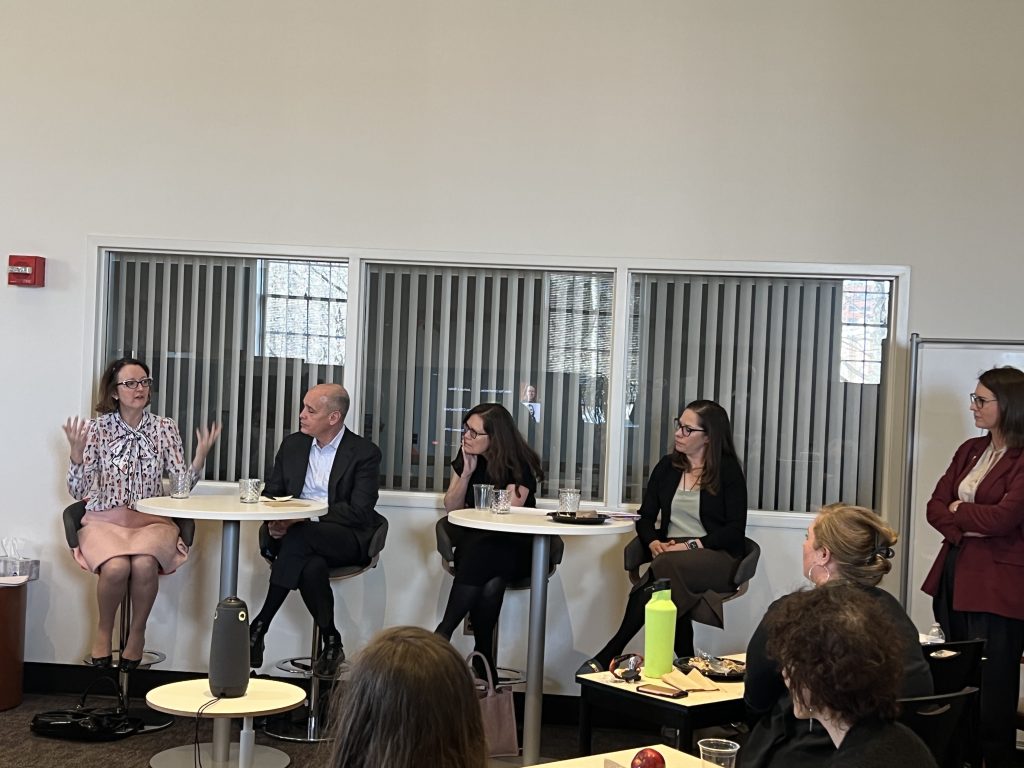
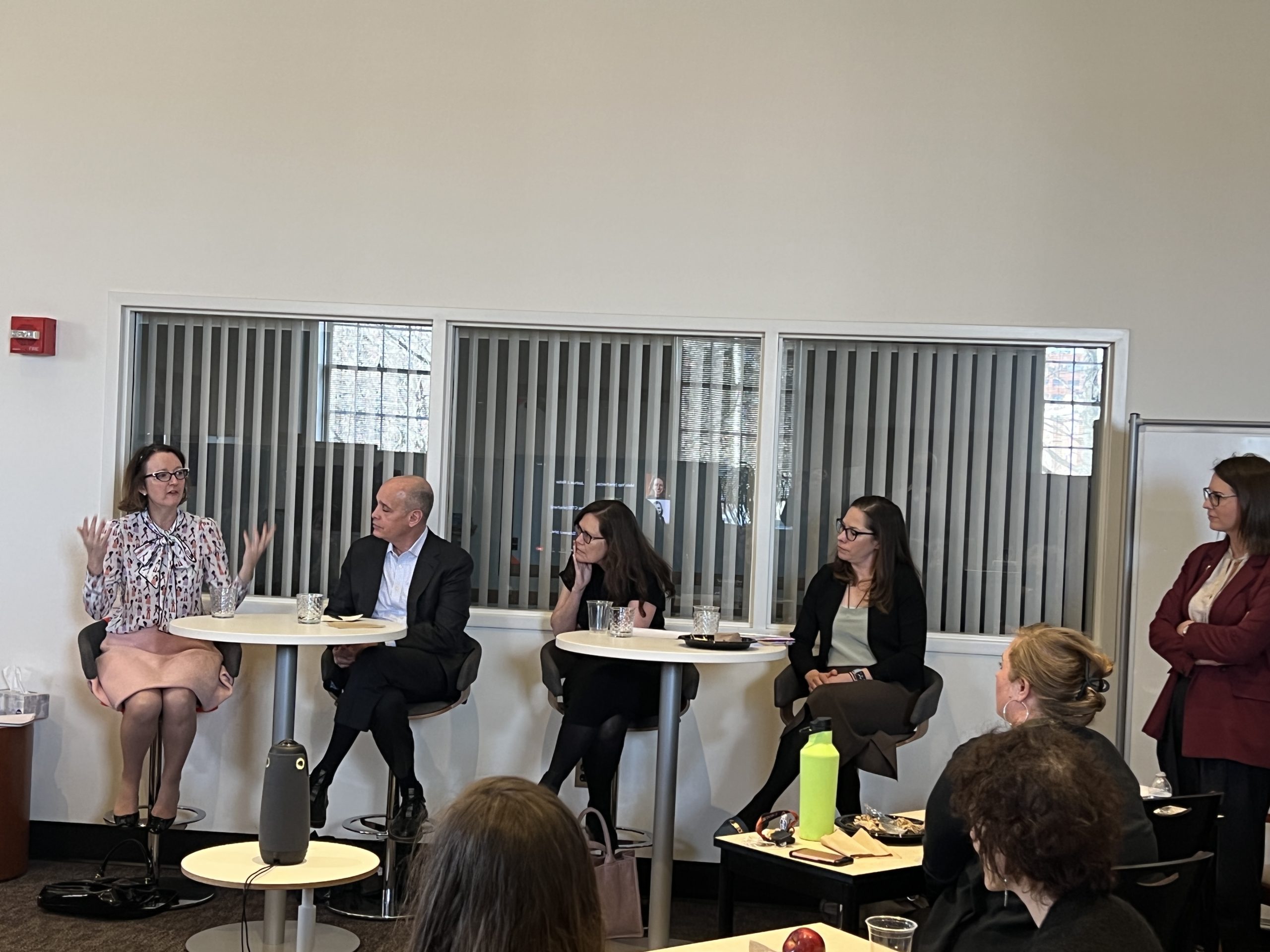
Lunch and learn panelists speaking.Dr. Watters summarized some of the emerging themes in the presentations and for FYS more broadly, including the need for source diversity and dynamism, modulating overly technical or discipline-specific content, incorporating experiential learning, and creating the space for more personal, low-key interactions between and among students and faculty. She then began the question-and-answer portion of the workshop which yielded active discussion with audience members. Here are some of the queries the panelists addressed:

Q: What is one concrete thing you did that worked really well?

CC: I asked students how they were doing and what was going on at the beginning of each class; it was a good way to “take the temperature” of the students and the room overall.
MO: I had students look at all sources we used in class, build a case, and present results. Finding evidence in the moment and figuring out how to talk about it worked well.
LM: Each week I had students do a written reflection asking what they learned, what questions they still have, etc.
KN: Examining ancient objects and exploring multimedia were very successful.

Q: I’ve heard from students that some FYSs are a lot of work. How did you all think about the work that you assigned to students?

KN: The feedback from my students was that the assigned work was actually light.
LM: I varied the workload each week. Sometimes there was a lot of reading, but then I lightened things up the next week with a podcast or some other activity. They seemed comfortable.
MO: I assigned different sources – documentaries, readings, etc. I tried to have them do something very short before class – fun and relatively easy – but enough that they were prepared to talk about something.
CC: I tried to keep assignments short. Short was key – I wanted to give all students a chance to participate.

Q: When you give writing assignments, do you comment on the writing? Are we trying to make these students better writers in FYS?

KN: Yes, I provided comments. I thought this was a core part of what we were doing and I wanted to help them.
CC: The fact that all students will take a writing-intensive course in the spring semester after their FYS (part of Krieger’s First Year Foundation of FYS plus First-Year Writing), takes the pressure off. I don’t think we need to spend too much time commenting on their writing.
LM: I graded all of my assignments complete/incomplete. I kept my comments at a higher level.
MO: I had the students focus on writing in smaller bits, which kept it doable for them, and therefore, not much commenting from me.

Another faculty member in the audience shared that when teaching his FYS, he included writing assignments where students had to write to different audiences, such as a letter to their parents or through the lens of an art critic. He said this kept them accountable to the sources, but that the versatility helped keep things “new and exciting” for students.

Q: Were students in your FYS from the same intended major or discipline, or were they varied in their academic interests?

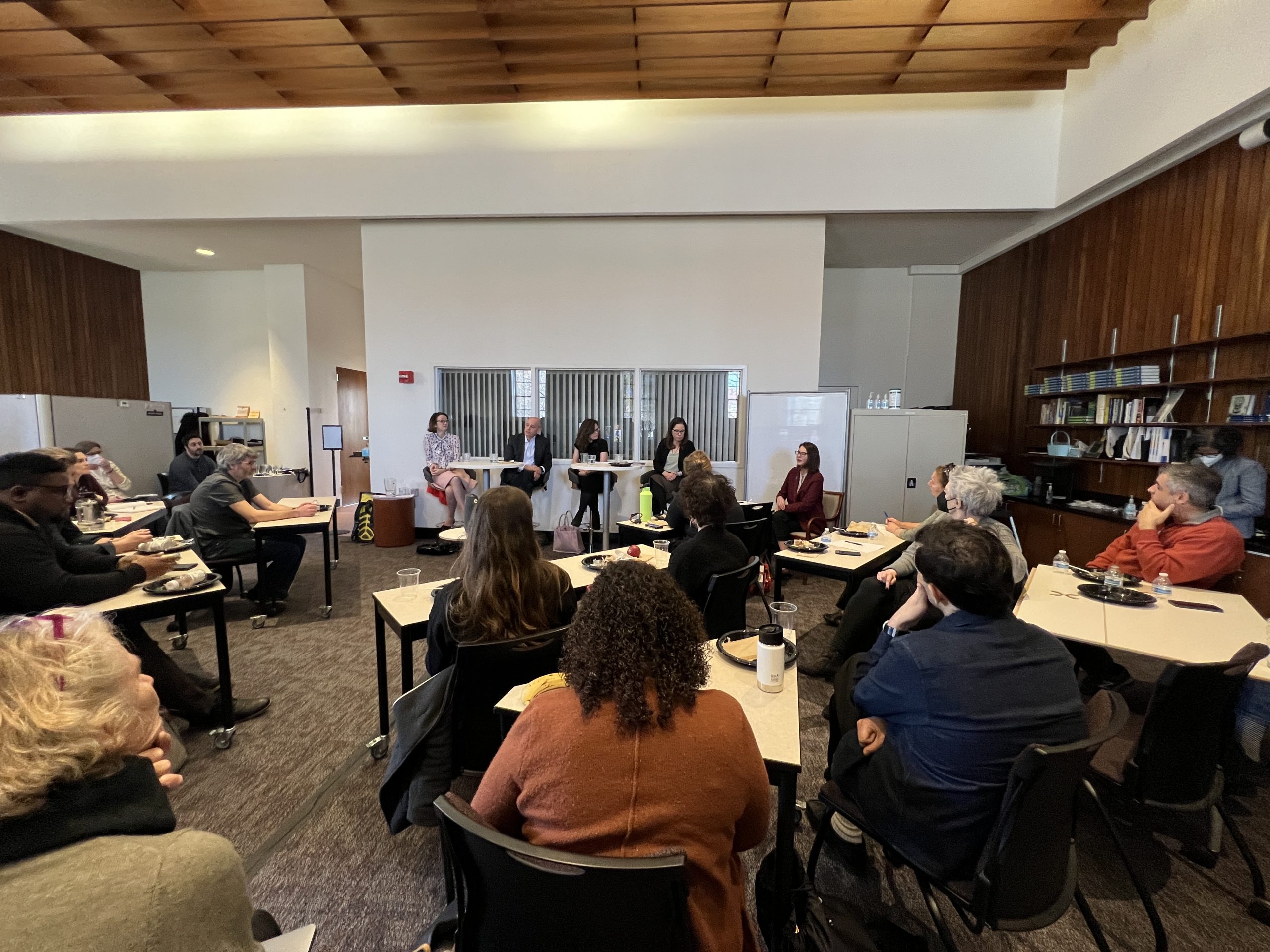
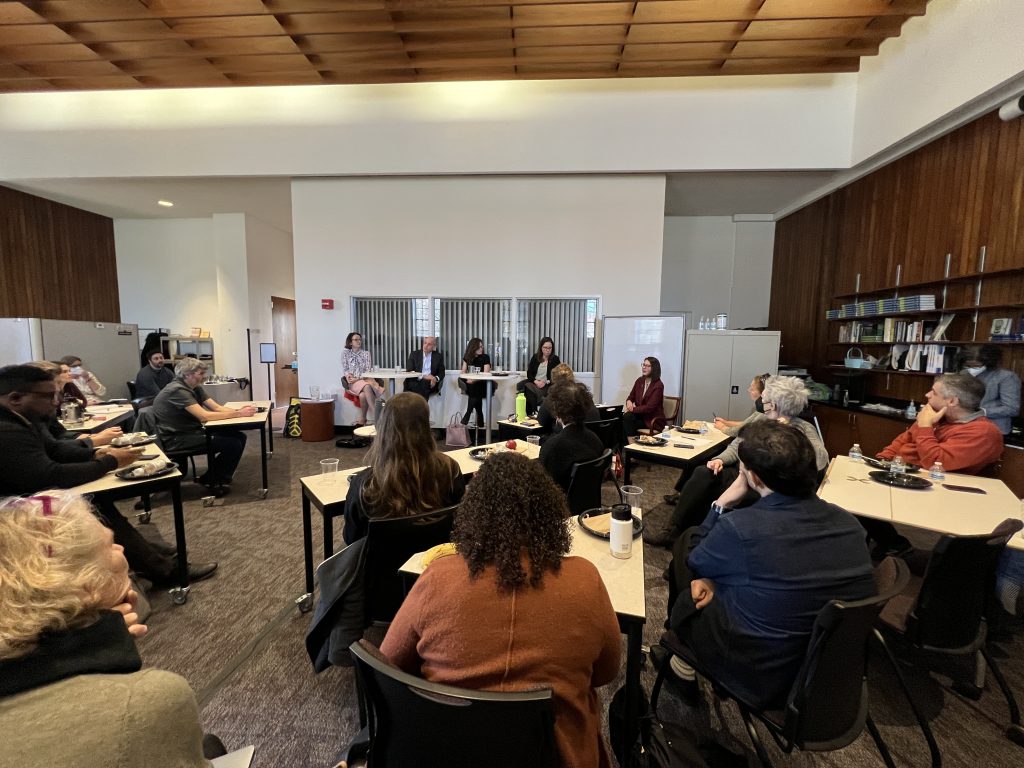
A: All panelists said their students intended to major in different fields; the students seemed to realize FYS was their chance to try something different, outside of their intended major or its related requirements. Several students commented to their instructors that the FYS sparked a genuine interest in a new field of study for them.A group of faculty listening to Lunch and Learn panelists.
Q: Who can we contact if we have concerns about something going on with first-year students?

A: Dr. Watters responded that being receptive to student experiences in the context of FYS is crucially important and encouraged instructors to contact the students’ advisors if needed. She also noted the role FYS can play in understanding and responding to broader trends percolating among students.

Q, from another FYS faculty member: In one of my courses, I allow students to co-design the syllabus for the class. Although it can be scary, it also takes some of the pressure off of me, as the students tend to be more prepared for things. Did you design the whole course, or did you allow students to develop any of it?  

A: While none of the panelists allowed students direct involvement in developing their syllabi, some commented that they did give students varying degrees of freedom in their assignments (such as what sources to use), some authority over class discussions, and independence in final projects.

Q: What is something you hope your students got out of your class?

KN: I think the social dimension that is built into this environment is enormously beneficial. For example, I took my students to a local diner, Paper Moon on 29th Street. It was so simple, but I felt like I really got to know them.
CC: Students want to get to know their professors – they are looking for mentor relationships and FYS helps develop those.
MO: The S/U aspect and small size of the seminars supports the social aspect. Students felt comfortable talking to me about their first semester. I was a non-threatening person in their life, despite being one of their instructors. I really enjoyed getting to know them in this way.
LM: I agree, about getting to know the students. I’m already writing recommendation letters for some of them! My hope, though, is that they maintain a curiosity for and joy of learning.

Dr. Watters concluded the session by reading an anonymous quote from the FYS student survey:

My FYS was my favorite class. Most of my other classes were large lecture style classes with 200 people so engaging with 11 of my peers in a small seminar environment helped me build meaningful connections. The instructor was also fantastic and he really got to know me. This was not just a ‘fun’ class. It was a class that was instrumental to making my first semester enjoyable. I made at least 4 friends in my FYS. I went to Peabody and the Visionary Arts Museum with my FYS group and explored Baltimore. Equally as important, it challenged me a lot and I gained skills that are critical.

Aliza Watters
Assistant Dean for the Undergraduate Curriculum and Director of First-Year Seminars
Krieger School of Arts and Sciences

Amy Brusini, Senior Instructional Designer
Center for Teaching Excellence and Innovation

Image Sources: Lunch and Learn Logo, Beth Hals
Teaching a Multi-Disciplinary Course

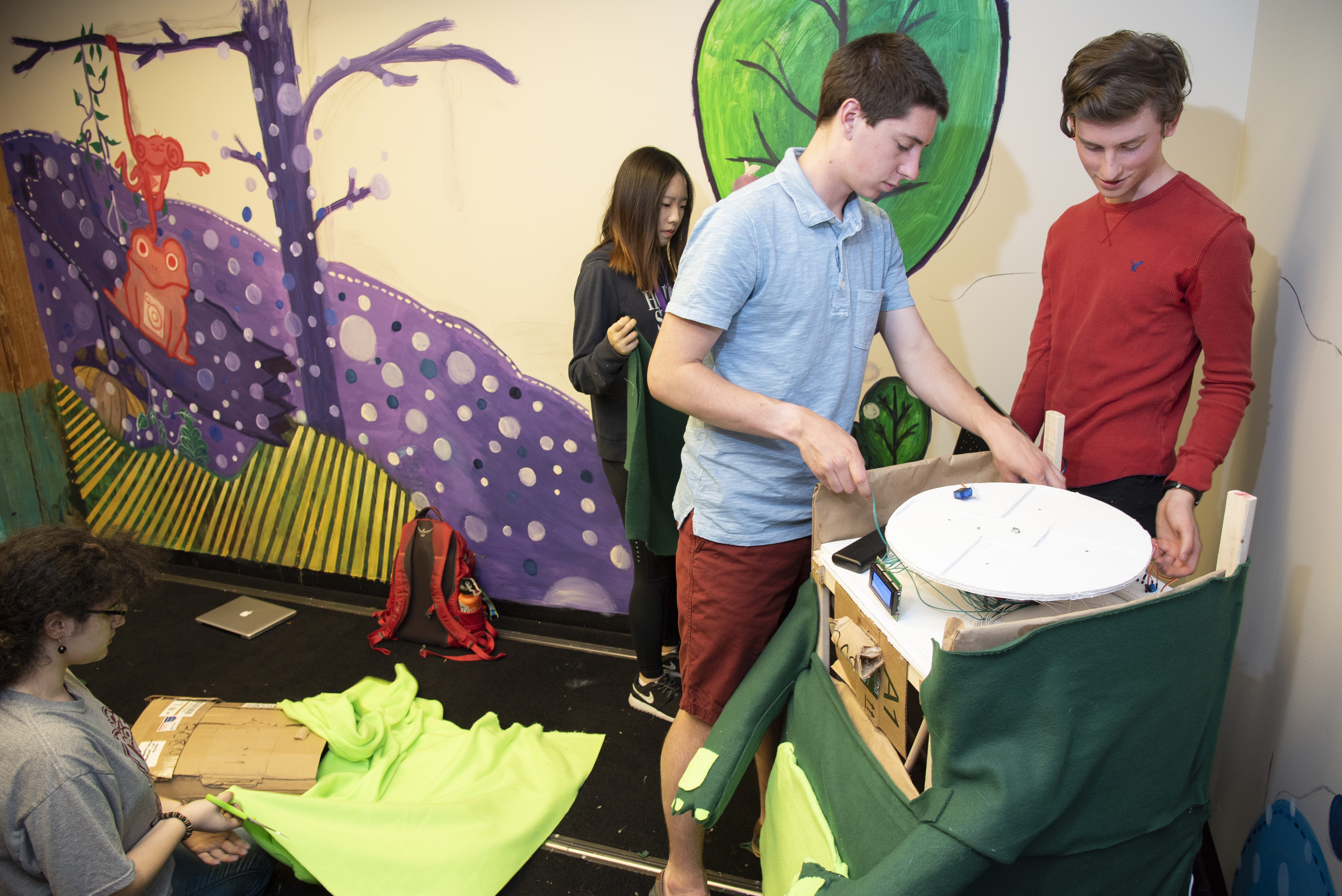
On Wednesday, October 16, the Center for Educational Resources (CER) hosted the first Lunch and Learn for the 2019-2020 academic year. Steve Marra, Associate Teaching Professor, Mechanical Engineering, Susan Weiss, Associate Professor, jointly appointed in Musicology at the Peabody Institute and the Department of Modern Languages in the Krieger School of Arts and Sciences, and Nathan Scott, Associate Teaching Professor, Mechanical Engineering presented on Teaching a Multi-Disciplinary Course.

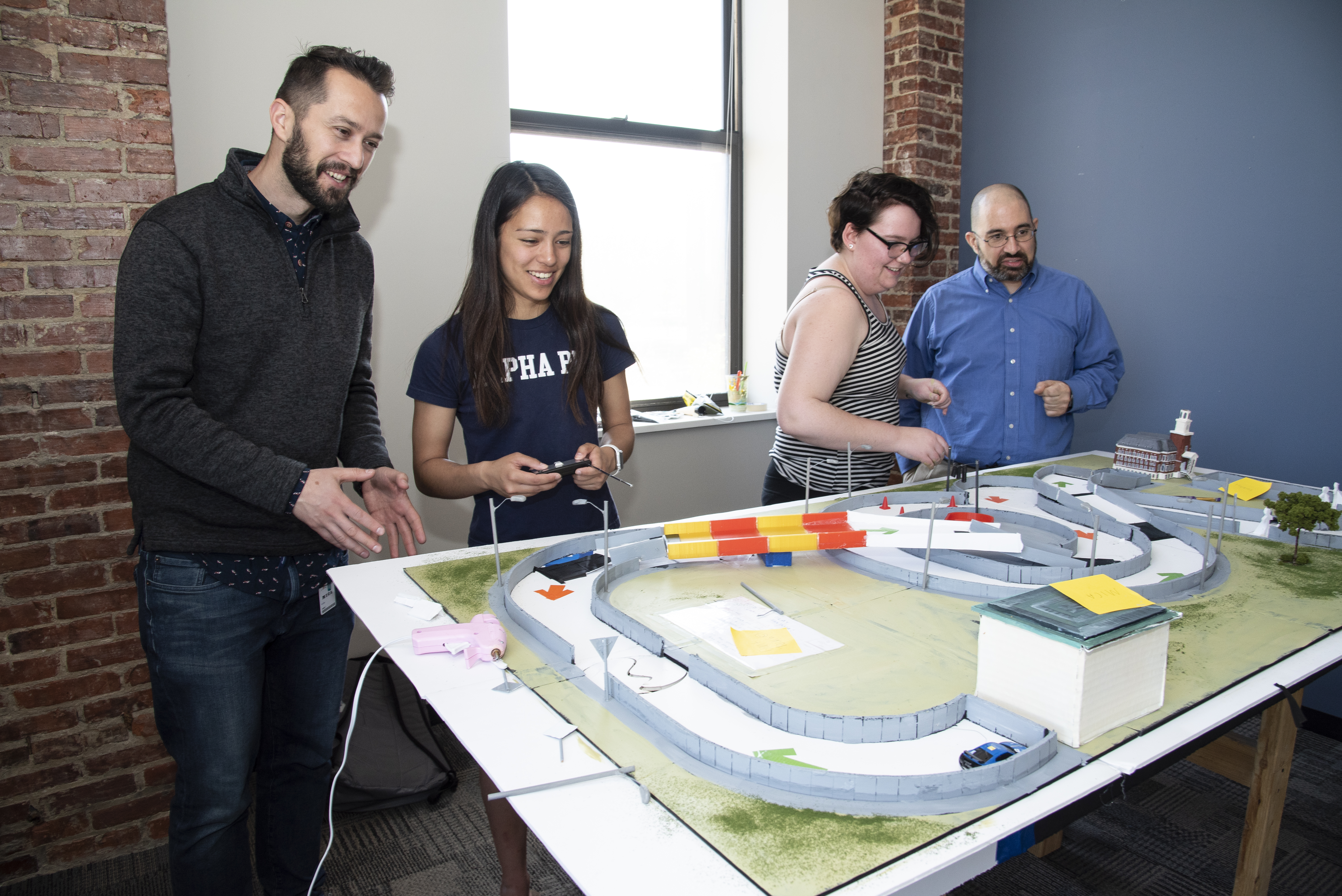
Steve Marra began the presentation by describing an Interdisciplinary Multi-Institutional Design Experience for Freshman Engineering and Art Students that took place in the Spring of 2018. This was a joint project initiated by instructors from JHU and the Maryland Institute College of Art (MICA). There were 44 students from JHU and 34 students from MICA who participated in the project. Marra described the project as having purposely vague specifications in order to allow for as much creativity as possible. Teams were given $100 to build something safe and interactive, with a variety of hard and soft materials over the course of 13 weeks that would “make your world better.” Each school determined its own grading schema; JHU students were graded on design reports and project notebooks, MICA students were graded on preliminary sketches and documentation, and all students were graded on quality of work. The project culminated with a week-long exhibition at MICA at the end of the semester.

Marra continued by describing obstacles encountered when implementing this project. One of the most significant challenges was scheduling and transporting students between campuses. While the faculty had considered this might pose a challenge in the initial stages of the project, transportation and scheduling conflicts were more of an issue than expected. Another challenge was the separation/isolation of work within student groups; in general, engineering students embraced the engineering tasks while art students gravitated toward the artistic tasks. They did work with each other but took on a ‘divide and conquer’ approach in most cases, rather than collaborating as much as the faculty had hoped.

Other unexpected challenges included:

  • Conflicting advice given to students by instructors. Marra commented that there was not enough collaboration between instructors ahead of time.
  • Staggered spring breaks between the two schools, resulting in two weeks of no work getting accomplished.
  • Multitude and diversity of projects due to vague assignment specifications. Marra commented that diversity of projects is normally celebrated, but in this case it made it difficult to efficiently assist students with their projects.

Despite the various challenges, student teams met their deadlines and created 18 projects in all for the exhibition. These included: a hugging machine, mega backpack, relaxation station, and a marble run. Marra concluded with suggestions for improvement:

  • Plan early
  • Develop a more focused assignment with very clear specifications
  • Schedule a kickoff meeting with icebreakers
  • Take time to teach teamwork and conflict resolution
  • Provide instruction on ideation
  • Develop an advising strategy
  • Do not underestimate the importance of convenient transportation

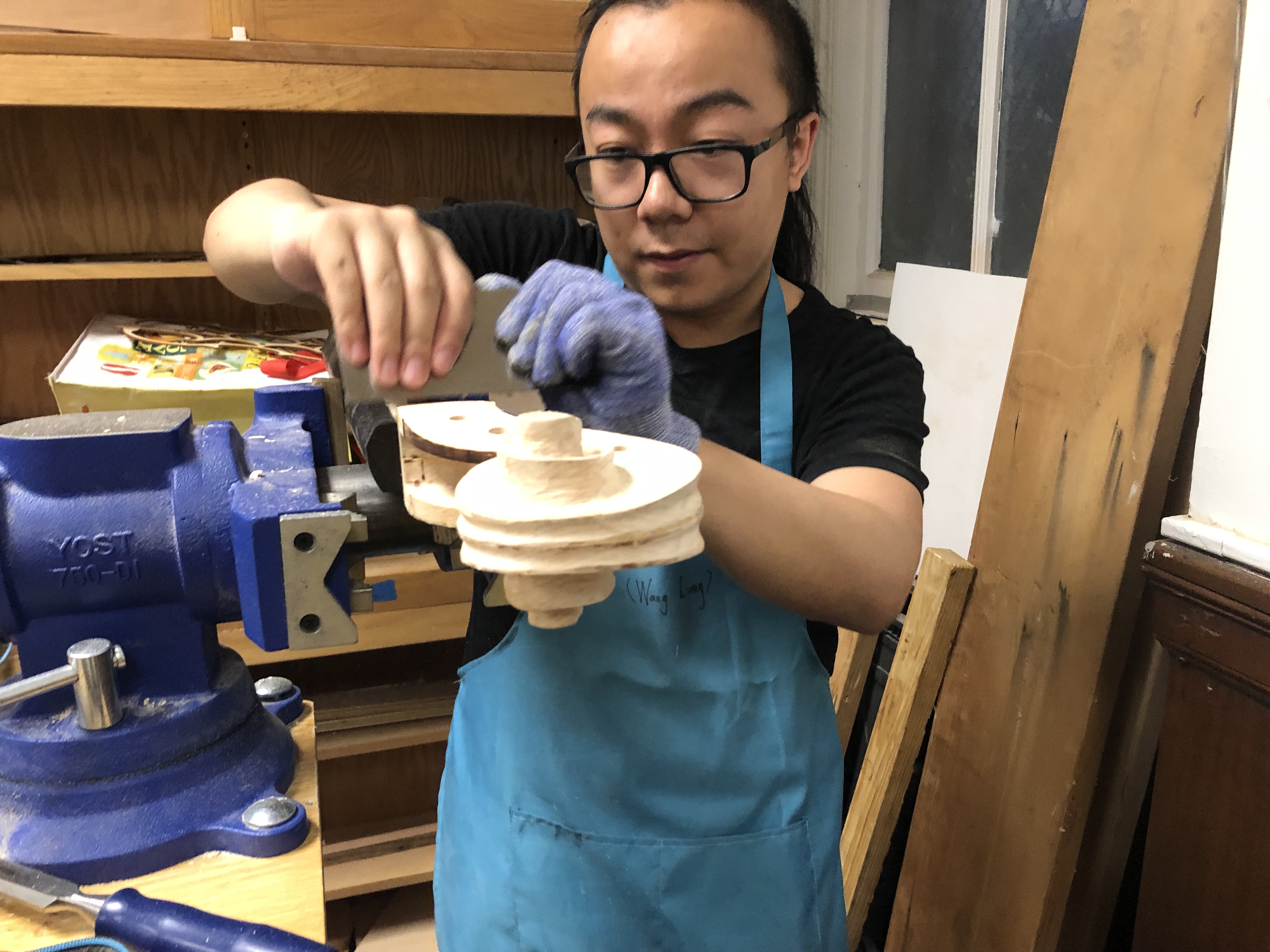
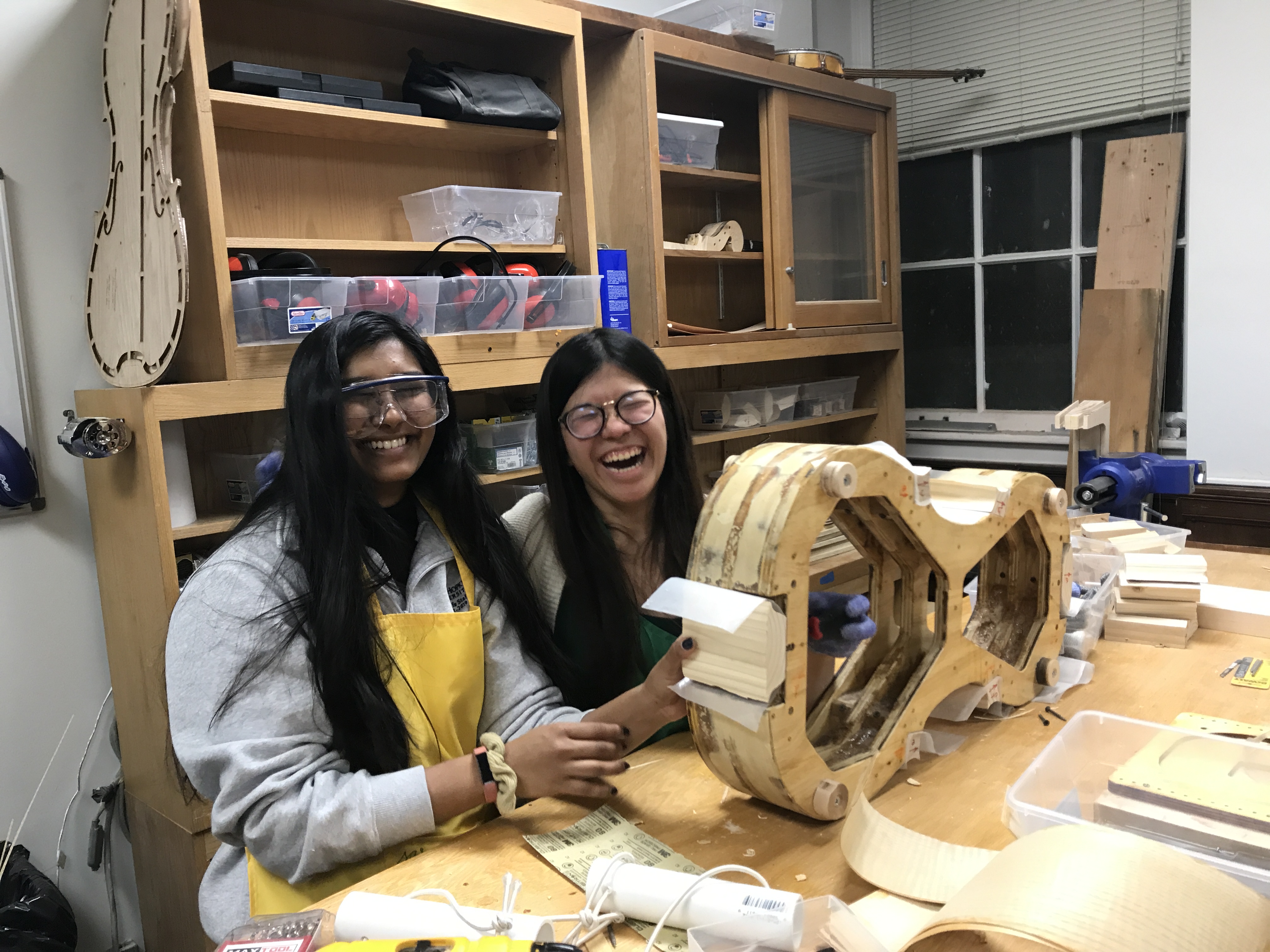
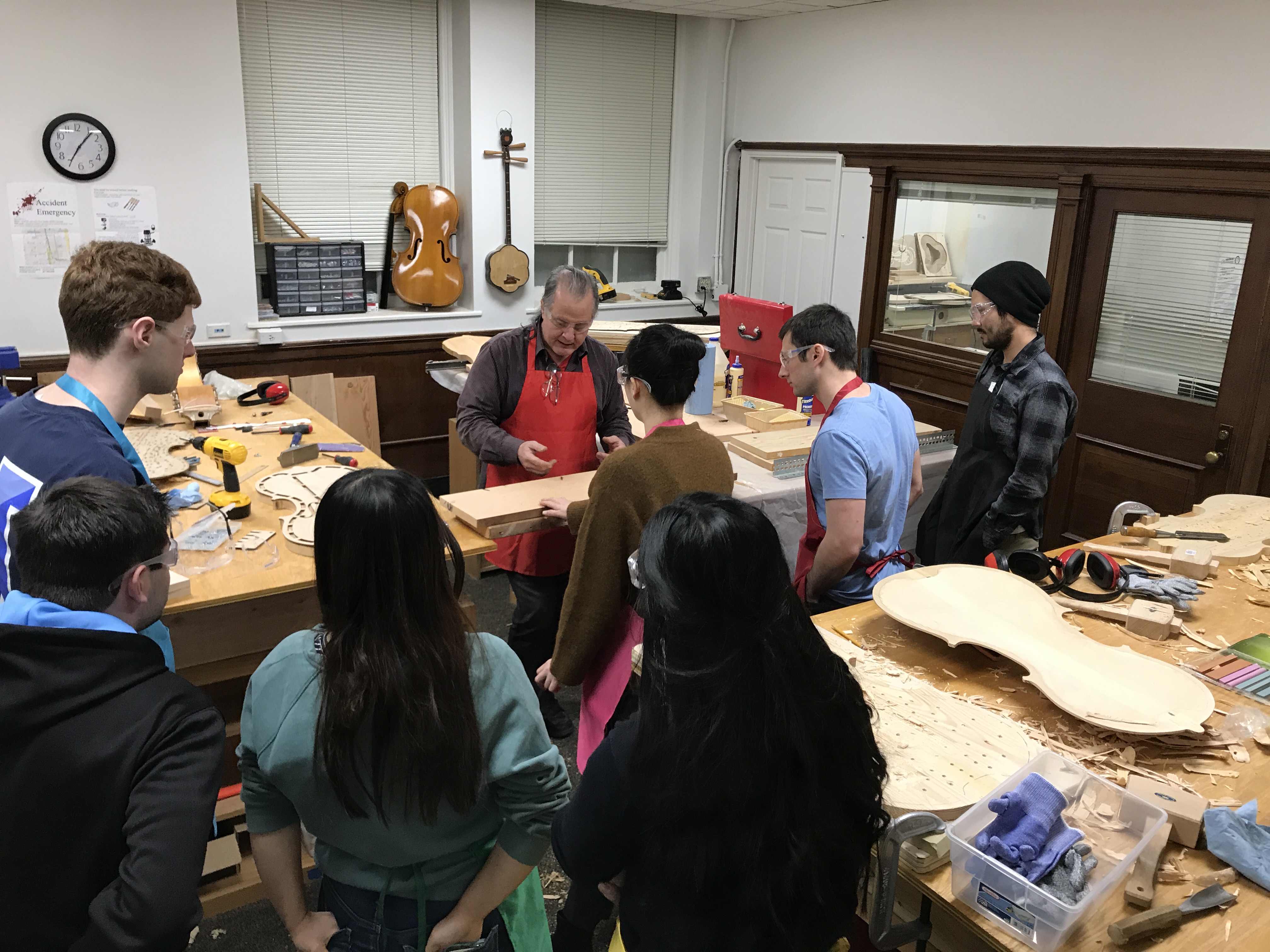
Susan Weiss continued the presentation by describing the course she co-teaches with Nathan Scott, History and Technology of Musical Instruments, which is offered jointly by ASEN and Peabody. Students are tasked with building their own instruments from scratch or repairing broken instruments in various states of disrepair. Materials used have expanded from simple cigar boxes and PCV pipe to much more sophisticated materials as the course has progressed and more funding has become available. Weiss noted that the content and direction of the course depends on the guests that are available to come in and work with the students during the semester, such as luthiers, professional musicians, guest speakers, etc. Students are graded on journal entries, weekly reflections, and presentations.

Weiss went on to describe some of the challenges with this course. One of the biggest challenges is the constant struggle to find a space for students to construct the instruments. In the past, students have used maker spaces at Homewood but most recently have been using a room in the basement of Peabody’s Leakin Hall. Finding the necessary raw materials can also be a challenge especially with budgetary constraints. Weiss also mentioned how students in this course tend to gravitate to their area of expertise, but that they have checks in place to ensure that students are sharing tasks equitably and learning from each other’s strengths.

Despite its challenges, the course continues to grow and evolve. When it first started, students were making cigar box guitars and other small instruments. Two years ago students built banjos; this past year, they took on the challenge of building cellos which they had the opportunity to play at the Whiting School of Engineering’s Design Day. Weiss noted how highly students rate this course and how much they appreciate the unique opportunity to collaborate and learn from other students.

Nathan Scott extended the presentation into a more philosophical discussion of what it means to be a student who embraces multi-disciplinary studies.  He likened a student who is not merely after a degree to a child who grows up in a bilingual or multilingual home.  That child, he stated, not only learns multiple languages naturally, but also has a brain now trained to learn skills more readily or easily than a child not exposed to multiple languages. He referred to this child as a ‘super learner.’

Scott noted that most research at JHU is multi-disciplinary and that there are fantastic opportunities for undergraduates to take part in this research and experience ‘super learning.’ He believes that our university, as a whole, could better design curriculum to ensure multi-disciplinary education for all students.  He suggested adding a graduation requirement for all WSE majors to complete a substantial, two-semester capstone project.  No classes would be held on Fridays, which would become ‘project days,’ so students from all majors could work together in teams to complete their projects.  In addition, students would have a collaborative space that would be their ‘home’ throughout their undergraduate years to develop community.

Below are some questions from audience members with answers from the presenters.

Q: (for Marra) The MICA/JHU course was worth one credit; wasn’t that a great deal of work for faculty and students?

Marra responded that while the course was only one credit, it was worth it because of the learning that occurred. However, if he did this project again, he would make some significant changes, such as limiting it to only Hopkins students to minimize the issues with logistics and schedules.  Marra did note that the credit hours rarely are a true reflection of the work necessary for the course by students or faculty.

Q: (for all) What is the payoff of the interdisciplinary course?

Scott reported that employers are hungry to hear about these experiences and meet students who have completed multi-disciplinary projects, not just taken x course or y course.  His ideal would be to have a campus design center where artists and experts in residence bring their skills to JHU and have student apprentices.

Marra remarked that interdisciplinary skills are different than team skills and that employers are recognizing the value of interdisciplinary skills. Students are often uncomfortable working in these types of environments and grow from the experience.

Weiss noted that students don’t necessarily have skills in one area or another, but as they collaborate, they discover each other’s abilities, and it is a revelation for them.

Q: (for Marra) How would you manage the issue of students gravitating toward their area of expertise if you ran this project again?

Marra responded that he would make it some sort of requirement that students demonstrate skills in their non-dominant major or skill set.

Read more about Steve Marra’s project in a recent HUB article. Read more about Susan Weiss and Nathan Scott’s course in this Peabody Post article.

Amy Brusini, Senior Instructional Designer
Center for Educational Resources

Photo credits: Steve Marra and Susan Weiss

Exhibiting the Avant Garde: Rare Primary Sources as Pedagogy

[Guest post by Molly Warnock, Assistant Professor, History of Art, Johns Hopkins University]

The library is often called the lab of the humanities. In my experience, the Johns Hopkins Sheridan Libraries embraces this role. I collaborate regularly with the Libraries’ staff to encourage students not only to use library resources to conduct their research but also to use the physical space to present their findings. In several of my undergraduate art history courses, students curate an exhibition as one of their major assignments. This article provides an overview of my collaboration with the Sheridan Libraries and describes a model that my colleagues are considering adopting for their own course projects.

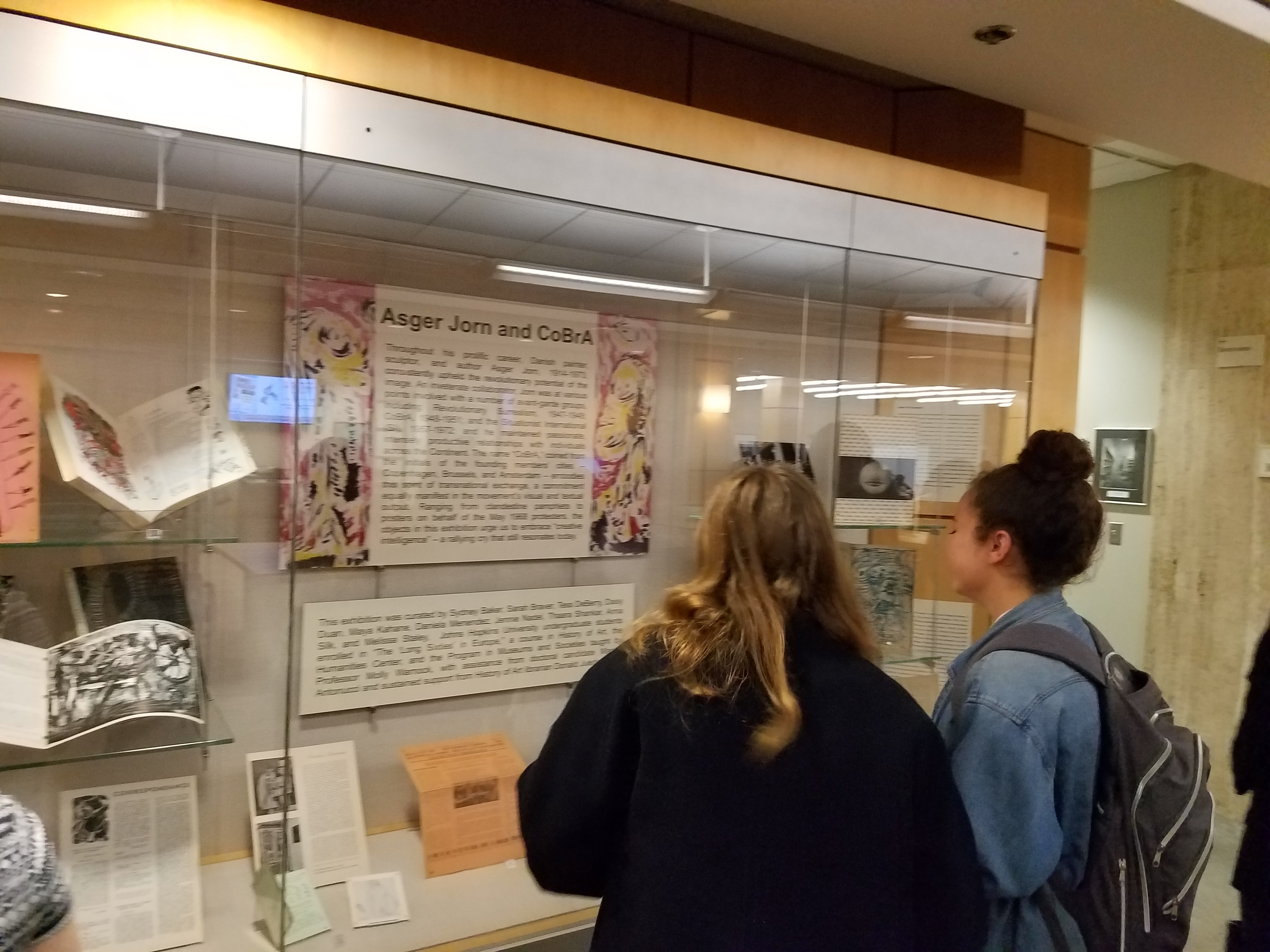
The collaboration began when I discovered the extensive modern and avant-garde collections owned by the Libraries, which boast vast reserves of journals, rare exhibition catalogues, and artists’ books, as well as posters, pamphlets, and other ephemera. I Students viewing library exhibitwanted to integrate these materials into my courses, and started by setting aside a day or two every semester to visit Special Collections. Now virtually all of my courses at all levels include multiple sessions of this sort. For example, my introductory survey “Modern Art, 1880-1950,” includes thematic visits devoted to such topics as Futurist typography, the role of journals and little magazines in the spread of experimental practices, and utopian urbanism. These visits allow students to see and in many cases handle rare primary materials, adding substantively to our discussions in the classroom. They are almost always surprised to discover the extent of our collections.

The curatorial seminars that I have developed over the past six years are specifically aimed at increasing student engagement with these important library holdings. Each course is in certain respects a traditional seminar, focused on some area of twentieth-century practice. We have weekly readings, look at digital slideshows, and discuss various case studies. At the same time, however, students immerse themselves in a semester-long, hands-on curatorial project centered on one particular aspect of our subject matter. The first such course, “Surrealism,” produced a survey of Surrealist journals (“Surrealism at Mid-Century”), while the second, “The ‘Long Sixties’ in Europe,” turned the spotlight on the library’s wealth of Lettrist books, journals, posters, photographs, and film scripts, among other items (“Presenting: Lettrism”). Additional iterations of “The ‘Long Sixties’” have focused on the library’s recently expanded trove of materials relating to the avant-garde group Cobra (“Asger Jorn and Cobra”) and on the Paris-based journal Robho (“Robho in Context”). Student contributions drive all stages of the project, including: researching and studying the available holdings; crafting a final object list; writing exhibition labels for the selected works; and designing the exhibition layout. At the exhibition opening, the students serve as docents, guiding interested members of the Hopkins community through the show.

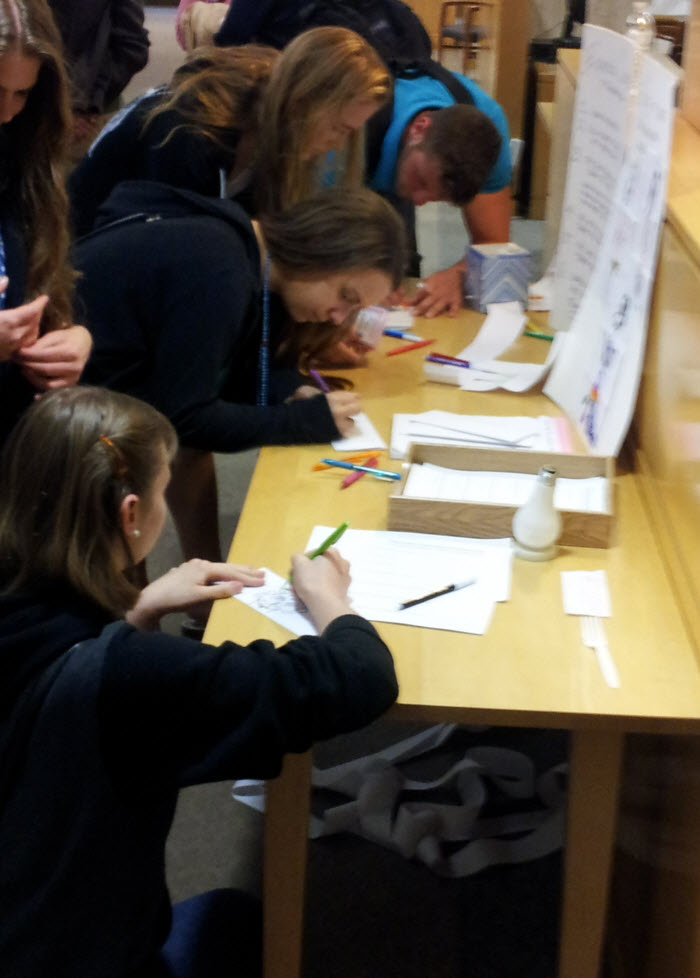
Students showing exhibit to library patronsCollectively curating an exhibition in one semester means negotiating difficult time constraints. I start my course planning by identifying a long list of objects relevant to my course. Throughout this period, I consult extensively with Don Juedes, the dedicated librarian for History of Art. We then meet with Mark Pollei and Alessandro Scola of the Conservation and Preservation team to ensure that the pre-selected objects are stable enough to be handled repeatedly and determine vulnerabilities that would have to be taken into consideration for exhibition—whether, for instance, a particular book or journal is especially light sensitive, or can only be opened halfway. Once the semester is underway, students begin working on the exhibition immediately. Within the first week, we’re in Special Collections, where students get their first peek of the objects cleared for exhibition; each selects a few to research individually. I provide some initial context, but encourage them to choose based on their broader interests or curiosity about specific items.

One of the course goals is to teach students how to interpret primary materials using different research strategies. Their first assignment is to outline a research plan for each of their chosen objects. Don introduces the students to library resources and teaches them the skills needed to conduct their research: for example, how to meaningfully generate and delimit searches in our online catalogue and how to navigate various databases and bibliographies. They have to locate relevant materials using the strategies Don has shared with them, and indicate how they plan to build an argument from these sources. This can be quite challenging in the case of objects that have not been studied extensively by scholars to date. I provide feedback and encourage them to think broadly about different angles of attack, from the more obvious (researching the artist or author) to the less immediately apparent (researching a gallery’s broader exhibition agenda).

By mid-semester, we are all back in Special Collections, where the students present their objects and recommend specific display options, based on their research findings and the various larger stories we might wish to tell. We then move into the most exciting—and difficult—phase: experimenting with different installation plans and whittling down our final object selection. We mark off spaces equivalent to the various display cases and physically move things around until we feel we’ve arrived at a coherent, visually compelling narrative.Students making adjustments to exhibit objects The Conservation and Preservation team stop by again to consult with us about our display concept, and then spend roughly a month and a half preparing the featured materials, building customized cradles, and installing the objects. The students use that same period to produce and collectively edit the banner text and individual object labels. The official opening usually takes place in the penultimate week of the semester and serves as a celebratory capstone for the course as a whole.

As an instructor, it is deeply satisfying to see how seriously the students take one another’s research, and how effectively a collaborative project of this sort can help to build community. I find myself continually refining my pedagogical approach to facilitate this. One crucial step was simply to limit the class size to a maximum of ten students. I’ve also explored the potential of new technological platforms to facilitate more lateral processes of peer-to-peer discussion and group editing. For example, having students generate and refine all exhibition-related texts in Google Docs allows me to afford class participants greater responsibility for the finished products, while still tracking individual contributions. This can be awkward at first, as students may not have prior experience giving one another constructive criticism. But they quickly learn that robust peer critique results in a better overall outcome: an exhibition that represents all of their contributions.

In their course evaluations, students rate this experience highly positively. One described “the opportunity to curate an exhibition and work with objects from the library’s collections” as “truly special,” while another called it “unlike anything I had done for a course at Hopkins before,” adding: “Interacting with one another so regularly to work on the exhibition also built a great sense of community among the students.” A third noted: “I really enjoyed getting to spend so much time physically with all these artifacts, and doing research on objects JHU owned.”

This project has also deepened my working relationship with Don Juedes. Don’s assistance has been instrumental at every stage. Early on, he helped me to put together an exhibition proposal and worked with the exhibition committee to significantly expedite the review process, which had previously taken several months. (Based on the success of previous course- related curatorial project, the Libraries now dedicate a regular slot in the calendar to our exhibitions.) He has also worked closely with library staff from multiple departments to streamline workflows and pin down a project timeline.

At the same time, Don and I consult regularly about the collections and often tailor new acquisitions in my research area to the courses I plan to teach and the kind of student-curated exhibitions that might accompany them.Students working to prepare exhibit For the students, there is an added benefit: working closely with Don teaches them the multi-faceted role that libraries play in supporting the scholarly community. They see that libraries are not just passive repositories but have a highly active custodial and, indeed, curatorial role, assembling and caring for the materials that enable forward-looking research and teaching. They learn the importance of developing relationships with library staff that can provide complementary expertise and assist in the discovery process. The students in these curatorial seminars often become avid library patrons, returning to use primary sources for other courses and independent research projects.

My partnership with the library has changed how I teach and opened up new learning experiences for students. I feel incredibly fortunate that the Libraries’ leadership and outstanding staff at all levels fully grasp the importance of teaching with objects and so generously support pedagogical innovation and collaboration in this area.

Molly Warnock, Assistant Professor
History of Art, Johns Hopkins University

In addition to critical surveys of modern and contemporary art, Molly Warnock’s recent and forthcoming undergraduate courses include several seminars with curatorial components, each focused on particular aspects of twentieth-century practice and culminating in an exhibition of journals and other ephemera from the Special Collections of the Sheridan Libraries. Recent graduate courses have explored the philosophical underpinnings of art history as a modern discipline; problems in abstraction; theories of painting and subjectivity; and the concept of an aesthetic medium, among other topics.

Image Source: Don Juedes

Lunch and Learn: Community-based Learning

On Wednesday, December 12, the Center for Educational Resources (CER) hosted the second Lunch and Learn for the 2018-2019 academic year. Shawntay Stocks, Assistant Director of Engaged Scholarship, Center for Social Concern; and Dora Malech, Assistant Professor, Writing Seminars; presented on Community-based Learning.

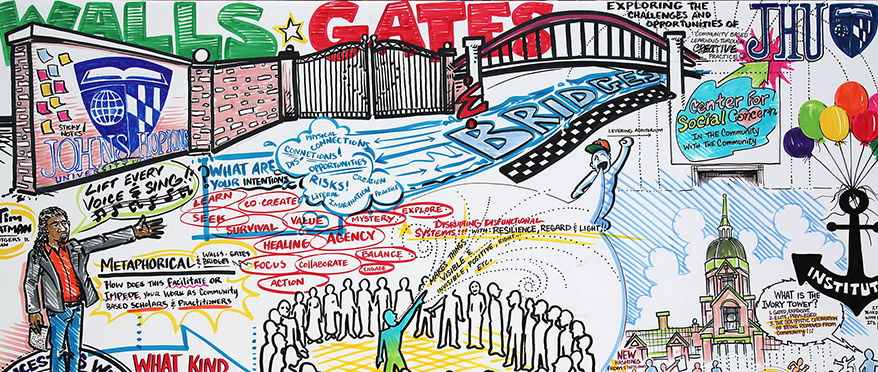
Graphic illustration of Community-based learning process.

Shawntay Stocks opened with a presentation on community-based learning (CBL) at Johns Hopkins speaking about how her organization—the Center for Social Concern (CSC)—can assist faculty who wish to use the CBL pedagogical model in their courses (see slides here). The Center for Social Concern is the part of the Homewood Student Affairs division of Johns Hopkins University that focuses on volunteerism and community engagement; Community-based Learning is just one of their programs.

Stocks described CBL as “…a pedagogical model that connects classroom-based work with meaningful community involvement and exchange.  Within the context of equitable partnership, community organizations and students mutually benefit from the CBL experience both by meeting course objectives and addressing community-identified goals.  Students may engage with groups including, but not limited to: nonprofits, government agencies, grassroots collectives, and other educational institutions.” She noted that collaboration is the key for faculty, students, and community groups in pursuing mutual goals and course objectives, and that faculty must provide adequate preparation for their students to engage in CBL. The Center for Social Concern offers training for faculty, stipends to support faculty and community partners, and provides a TA for courses using CBL. At the core CBL is an equal partnership. The community partner may not have an advanced academic degree, but does have expertise, relationships, and contextual knowledge to bring to the table.

Students benefit because CBL allows them to connect theory to real-life experience and to think critically, in our case, about urban life in Baltimore. They have the opportunity to work collaboratively and collectively and gain an understanding of diverse perspectives. The skills they develop will be transferable to other aspects of their lives. Students often transform their thinking about the city in positive ways as they gain knowledge through reflection.

How can faculty ensure a successful CBL experience? Stocks emphasized the importance of “doing your homework” in terms of the community partner. You should think about these questions: What are the areas of commonality? How do your academic goals and their programmatic goals overlap? What are the expectations on both sides? What types of training will students need for a successful partnership? What are the logistics for partnership meetings? What commitment is being made (e.g., one semester, multiple semesters or academic years) and what is the potential for an ongoing partnership? What type of action are you planning for your CBL course—research, service, community building, advocacy, dialog?

Critical for the student experience are reflection and assessment. Reflection deepens learning. Instructors must allow for students to express their discomfort, frustration, anxiety, anger as well as their positive, affirmative feelings. It’s important to have conversations around the emotional impact of their experiences and acknowledge difficulties. Assessment of learning can be done through journaling, discussion, essays, or presentations.

At the end of the course there should be a project evaluation that includes the community partner. How did the partnership work? Were the learning goals accomplished? What would make the partnership work better? What were the pitfalls? How can these be navigated next time?  CBL courses may be iterative processes and such evaluation will allow for continuous improvement of the experience for all involved.

Dora Malech won the Crenson-Hertz Award for Community Based Learning and Participatory Research from the Johns Hopkins University Center for Social Concern in 2016. For the past several years she has worked with CSC, partnering with the Writers in Baltimore Schools (WBS) program to give her Johns Hopkins Writing Seminars students a CBL experience. The WBS website has more information on this partnership. Malech shared her experiences with developing and teaching her course, Poetry and Social Justice.

Malech teaches undergraduate and graduate students now, but previously, at the University of Iowa, she directed a K-12 outreach program, which gave her an appreciation for community partnerships. In thinking about CBL, an important component for her is the concept of cultural humility, which comes from social work, a profession that emphasizes diversity and cultural competency. This idea of respecting the different experience of others and being open to learning from them works well for those interested in implementing CBL.

When she was first considering CBL, she made a lot of phone calls to prospective partners. Malech recommends meeting face to face, having coffee, getting to know the person. She ended up partnering with Patrice Hutton from the Writers in Baltimore Schools program. The program starts with Middle School students who participate in “in-school, after-school, and summer programming that builds skills in literacy and communication while creating a community of support for young writers.” Malech’s Writing Seminars students worked with Baltimore City high school students who had been program participants.

For the students on both sides, it is important to frame the relationship as a two-way transaction. The high school students have the experience of growing up in Baltimore City. They have cultural wealth and knowledge, and can articulate the community concerns. These students are college bound, but university culture is very much an abstraction for them. The JHU students may know nothing about inner-city life; the high school students give them the benefit of their urban experience, while the JHU students can help break down the mystery of what college life will be like for their high school partners.

Malech is explicit with her students about the course requirements. Participation in events outside of class time is mandatory—these include field trips, interview assignments, literary readings. Students are expected to get to these events on their own. Purchase of a Maryland Transit Administration CharmCard is recommended, and students should become familiar with public transportation such as local buses, light rail and the MARC train to DC. Due to logistics (the high school students are coming from all across Baltimore City), and to the high school students’ expressed preference, the class meetings are held on the JHU campus.

Malech said her role is to be explicit that the text is the community itself and that the students will build it together in the classroom. An on-going class blog—Poetry and Power—captures student writings. From the web site: “POETRY & POWER is the website and blog of “Poetry & Social Justice,” a Community Based Learning class that brings 15-20 Baltimore City high school students and 15- 20 Johns Hopkins University undergraduate students together to explore the intersection of poetry and social justice. They’ll write and read poetry together, engage with visiting writers, interview local poets and activists, and hold public performances of their own.”

As Stocks emphasized, Malech also views critical reflection as a key component for CBL. She uses the DEAL Model for Critical Reflection from Patti Clayton’s web site PHC Ventures (Mission: To build capacity for and generate best practices around community-engaged teaching, learning, and scholarship.), which Malech recommends as a great resource for those engaging in CBL.

A discussion followed the presentations. Stocks gave examples of different models of CBL. In one case a STEM faculty member and his class developed course modules to augment STEM programming at Margaret Brent Middle School. She fielded questions about whether it would be possible for Engineering capstone courses to use CBL with identified partners, specifically whether Civil Engineering students might partner with city agencies to identify and resolve infrastructure issues. This is an intriguing possibility that may be pursued with faculty and deans in the Whiting School of Engineering.

A question was posed about how to get departmental buy-in and funding for CBL courses. Malech noted that she had to prove that the concept was pedagogically sound and not overwhelming for the students. Strong positive feedback from the students showed that this was a high-impact teaching model. She said that she worked very hard to make the course a success. Getting positive publicity can be a strong incentive for department backing. Media attention acts as a “witness” to the process and as pressure for the administration to continue a project. She also presented at conferences and made the connection between strong writing and community engagement. Malech stated that culture change is an uphill battle where positive community feedback can really help. Being flexible and willing to scale up or down is important as well. The JHU President’s Office is advocating for community engagement, which may also be useful in getting departmental approval.

Stocks reminded us that CSC has resources for faculty and can assist even if someone wants to start on a small scale and build up to greater community engagement. Mike Reese, who uses CBL in his Sociology courses (focused on Baltimore City) noted that CSC had helped him get a JHU van to transport students for field work assignments. Stocks referenced the CSC website page for faculty wanting to use CBL—there are resources listed. She invited interested faculty to come have a conversation and learn more.

A question was asked about how a course could be restructured to include a CBL component. Faculty who have implemented CBL agreed that the activities must be the core course fabric. Traditional assignments can be swapped out for CBL assignments; class time can be used, or time outside of class can be substituted depending on the activity. Both the Center for Social Concern and the Center for Educational Resources can assist faculty with course planning.

Several participants who have used CBL in their courses stressed the importance of structuring and scaffolding the experience for students to assure that they buy into the concept. Malech emphasized that students should be prepared for the fact that there will be a certain amount of chaos inherent in the program, and that interpersonal relationships can be challenging. That is part of any real-world experience, but if students are prepared, they will be able to adapt. Another faculty CBL user noted that it is never a majority of students who feel “unsettled” by the realities of city life and partnership, but for those who are it is important to keep communication lines open and be flexible. And someone else noted that the “chaos factor” is also part of the equation for faculty and doesn’t go away even after multiple experiences offering CBL courses. In her experience, the chaos is well worth the meaningful, long-term impact for students. Malech commented, “That’s what college should be all about.”

Ahmed Ibrahim, Senior Education Research Consultant in the Center for Educational Resources, has been analyzing data on CBL courses taught at JHU from 2015 to 2017. He shared that students indicated that the best aspect of CBL courses is the personal interaction. Students asked for negative aspects made comments when the course was not well-structured.

Mike Reese, Director of the Center for Educational Resources asked Stocks and Malech what the best thing about CBL has been for them. Stocks answered that she enjoys creating CBL partnerships and wants to further engage faculty in a CBL learning community. For Malech, it has been the publishing and presenting as an educational expert outside her field of poetry. In terms of the learning process, she has come to think differently about course content. While originally she was focused on social justice and lived experience for the high school students, they challenged her to allow them to be creative writers. She’s appreciated the chance to be more open about her own assumptions of what the community partner wants and needs.

Macie Hall, Senior Instructional Designer
Center for Educational Resources

Image Sources: Center for Social Concern, Community-based Learning web site: https://studentaffairs.jhu.edu/socialconcern/programs/community-based-learning/


Managing Students’ Emotions while Facilitating Active, Peer-to-Peer and Experiential Learning in the Class

silhouette  of a human torso with heart and brain. How do you deal with disengaged students in your class? Those students can easily be discounted as people who “just don’t get it.” We can label them as “dysfunctional” and be comforted thinking that we can’t make every student happy in our classes. But what if your assumption is that your responsibility is to create a learning environment where transformations – from bored to engaged –can happen? What if the actual content you are teaching, and the learning you are hoping to achieve, has an emotional component?

Key questions comes to mind:

  1. Does learning involve both cognitive and affective/emotional work?
  2. How do we do this affective work and how do we balance the need for dealing with it in a way that doesn’t make the class a “shrink” session?
  3. If we agree that facilitating experiential learning is more effective than lecturing in the class, how do we develop acceptance in instructors and students of the feelings that arise during the learning process?
  4. What conditions can make the work of managing emotions in the class easier for facilitators and participants?

Does Learning involve both cognitive and emotional work?

Dualism, the idea that thinking and feeling are separated can be traced from Plato to Descartes, and from Kant to the Logical Positivists. Day-to-day life is permeated with expressions like “Don’t be so emotional!”, “Let’s leave emotions out of this discussion” or even using the word “passionate” to mean erratic and unpredictable, at least in Anglo Saxon cultures. The message is clear: emotions do not belong in a class.

Dualism has been proven to be false; cognition and emotion appear to be dynamic, interactive and interdependent. Research shows that emotion and cognition jointly contribute to the control of mental activities and behavior. Even in classes where a highly-technical subject matter is taught, the learning process is impaired when educators rely on a theory of learning that is exclusively “above the neck”. This makes emotions not-discussable, which in turn makes this decision itself not-discussable.  Thus the role of emotions during the learning process becomes a hidden process that plays a role never fully understood or leveraged for learning success. Learning does involve both the cognitive and the affective domains and educators can learn how to create the right mix.

As an adaptive leadership practitioner and experiential educator, I treasure the distinction between Ron Heifetz’s learning “above the neck” (the intellectual faculties, the home of logic and facts), and learning “below the neck” (the emotional faculties, the home of values, intuition and inner purpose). Heifetz’s great intuition is that leadership work – and that of educators – is about “managing the gradual process of easing people into an uncomfortable state of uncertainty, disorder, conflict, or chaos at a pace and level that does not overwhelm them yet takes them out of their comfort zones and mobilizes them to engage in addressing an adaptive challenge.”

How do we do this affective work and how do we balance the need for dealing with it in a way that doesn’t make the class a “shrink” session? Are emotions expressed in the class a sign of failure or success?

I see emotions as expressions of deeply held beliefs and our work of educators as getting in touch with this inner dimension in order to gain greater awareness. I can only do this work with emotions in class if I am able to explore and handle emotions myself. Exploring emotions during the adaptive change that deep learning is, I have found that the emotion of fear (e.g., fear of loss, fear of the unknown) has the greatest significance. Fear impairs our individual and collective capacity to learn by distracting us and diverting our energy into self-protection. We can deal with that fear head-on by encouraging our students and strengthening their motivational resilience. Dealing openly in the class to counter the idea that learning is only cognitive affair might be a start, as well as dealing with student’s expectations. Indeed students show up for a class with clear expectations:

They expect the work to be at a cognitive level as many individuals – emotionally intelligent in their personal lives – believe in the classroom they must be completely logical and remain emotionally unaffected by their experiences. This idea keeps students from discovering useful information and keeps them from crafting creative solutions.  They also expect the instructor will convey course content in a traditional way (often through a lecture consistent with their previous experiences).

As educators we can decide to keep the conversation at the “cognitive level”. But if we embrace learning as both cognitive and emotional we need to engage courageously with the following paradox:

  • If we meet learners’ expectations of a purely cognitive experience we do not serve them well especially in classes where the premise and purpose of the work is intentionally transformational and centered on personal growth.
  • If we disappoint learners’ expectations (and teach a kind of knowledge that is cognitive/emotional in nature and process) we may generate anxiety; and force our students to renegotiate the social contract with us as authority figures, a contract with which they are familiar and comfortable.

Expression of emotions are neither a sign of success nor a sign of failure, but I do know that classes where emotions are not expressed are more likely to be ineffective.

If we believe that experiential learning is more effective than lecturing because it mirrors more closely the real world, how do we develop acceptance of the feelings that arise during the learning process in both instructors and students?

While there may be no “right way” to manage this complex process as a facilitator, I have found from my personal experience that the following to be helpful:

  • Listening and speaking from the heart. Listening from the heart means understanding what others are feeling; speaking from the heart means expressing what I am feeling. This communicates the values at stake, the reasons that make it worthwhile for people to deal with their temporary discomfort and stay in the game. For example if I talk about something sad and feel the urge to cry, I do not end my class prematurely or walk out of the room: I allow myself to feel while also seeing my class through. By doing this, I let my students know that the situation is containable, that I can stay with the emotion and that they can, too.
  • Allowing for silence. Resisting the urge to fill the silence might be one of the most powerful ways to support students’ expression of their feelings. Marcia Reynolds, the author of “The Discomfort Zone” states “Silence is holding a space of care and trust as a person’s brain tries to make sense of what it is learning…You don’t want to interrupt when a person is processing a question you asked. Silence is more effective than trying to make someone feel better…If you quickly shift the person from feeling negative to positive, going away from the problem to what is possible…the person might feel ashamed for continuing to feel angry or frustrated during or after the conversation. His or her real needs remain unspoken.”
  • Asking myself “What person’s essential values/commitments has been so violated that it justifies these feelings?” I address this issue openly and encourage a sense of adventure and moderate risk-taking. I remind students that in their professional lives they will probably deal with issues that are confusing and unclear. I continue to issue several invitations that encourage the more controlled-minded individuals to “go with the flow, by “renting the ideas” rather than buying them to see where these ideas might lead them.
  • Being comfortable with conflict. I have no problem with a high range of emotions being expressed in the class. My belief is that the power of dialogue can get people far and that we are all better off when we learn with and from each other. Differences can become an exhilarating window into other worlds and ways of seeing the world.

In summary…

In summary, I hope you can see how the courage to be vulnerable and to embrace emotions in the class transforms the way we teach and the way we learn; and how important it is to model for our students the courage our cognitive as well as our emotional selves be seen. Vulnerability is the path if we want greater clarity in our purpose as leaders.

I have discovered that a learning process that allows for vulnerability both of instructor and students makes it easier to courageously seek our authentic purpose as teachers, learners and leaders.

We will do better in our work as educators when we decide that taking risks, braving uncertainty and opening ourselves up to emotional exposure are no longer weaknesses to be feared, rather crucial decisions that ultimately define the quality of our own learning journey, of our work and ultimately of who we are, for our students and especially for us.

For Further reading

  • Heifetz,R., Grashow,A., and Linsky,M., The Practice of Adaptive Leadership (HarvardBusinessPress,2009)
  • Nussbaum, M. “Upheaval of Emotions”
  • De Souza, Renner “Not Knowing”
  • Reynolds, M. “The Discomfort Zone”
  • Baldwin,C. ;Linnea,A. “The Circle Way. A leader in every chair”
  • De Mello, A. “Awareness”
  • Pianesi, A. “Journey to chaos and back: Unlearning in workplace training programs” The Systems Thinker
  • Web site: caseinpointmethod.com by Adriano Pianesi and Jill Hufnagel

*********************************************************************************************************

Adriano Pianesi is a leadership development consultant and principal of Leadersh1p.com. He teaches leadership experientially at the Carey Business School Johns Hopkins University, at the State Department, at the World Bank and at Microsoft. He has worked in the last 20 years in the private, nonprofit, government sector, and in international organizations. A passionate experiential educator, World Café host, and Adaptive Leadership enthusiast, Adriano can be reached at adriano@leadersh1p.com.

Image source: by Macie Hall remixed from “Man shadow – upper” by Mikael Häggström – File:Upper body front.png. Licensed under Public Domain via Wikimedia Commons – https://commons.wikimedia.org/wiki/File:Man_shadow_-_upper.png#/media/File:Man_shadow_-_upper.png and Pixabay.com

Definitions

Recently, in discussion with some colleagues, confusion was expressed about the terms inquiry-based learning, problem-based learning, case-based learning, and experiential learning. How are these alike and how are they different? Are there overlaps? What distinguishes one from another? I thought providing some short definitions of these terms, along with a few resources, might be useful to others seeking clarity.

Group of students working togetherInquiry-based learning (IBL) is a term used broadly to include pedagogical approaches that put the students at the center of the learning process, allowing them to undertake investigations by asking questions to solve problems. The University of North Carolina has published an annotated bibliography of resources on IBL.

Problem-based learning (PBL) is described by the Institute for Transforming Undergraduate Education site, Problem-Based Learning at University of Delaware: “In a problem-based learning (PBL) model, students engage complex, challenging problems and collaboratively work toward their resolution. PBL is about students connecting disciplinary knowledge to real-world problems—the motivation to solve a problem becomes the motivation to learn.”

And in Why PBL?, “In a problem-based learning (PBL), students work together in small groups to solve real-world problems. PBL is an active and iterative process that engages students to identify what they know, and more importantly, what they don’t know. Their motivation to solve a problem becomes their motivation to find and apply knowledge. PBL can be combined with lecture to form a hybrid model of teaching, and it can be implemented in virtually all courses and subjects.”

A widely cited book by Maggi Savin-Baden, Problem-Based Learning in Higher Education: Untold Stories [McGraw-Hill International, 2000], provides an in-depth look at PBL. See an excerpt here.

The Center for Teaching at Vanderbilt University has a teaching guide on team-based learning. “Team-based learning (TBL) is a structured form of small-group learning that emphasizes student preparation out of class and application of knowledge in class. Students are organized strategically into diverse teams of 5-7 students that work together throughout the class.  Before each unit or module of the course, students prepare by reading prior to class.” The guide provides information on theory and structure, as well as a section called Where can I learn more?, which references the Team-Based Learning Collaborative as well as books and articles.

Case-based learning employs the use of discipline-specific, situational narratives as a launch pad for student learning. A case-based learning wiki from the Department of Educational Psychology and Instructional Technology, University of Georgia tells us that “[c]ase-based learning can cover a wide variety of instructional strategies, including but not limited to, role plays, simulations, debates, analysis and reflection, group projects and problem-solving. It provides a great deal of flexibility at the practical level.” The wiki not only describes the characteristics of case-based learning, but also discusses how to implement it – defining both the instructor’s and the students’ roles, offers some information about developing cases and designing learning activities, gives an overview of assessment, and provides references. See also The Innovative Instructor post Quick Tips: Using Case Studies.

The Center for Teaching and Learning at the University of Texas Austin defines experiential learning as “any learning that supports students in applying their knowledge and conceptual understanding to real-world problems or situations where the instructor directs and facilitates learning.” These experiences can take place in a number of settings including classrooms, labs, studios, or through internships, fieldwork, community service, clinical or research projects. The UT Austin webpage on experiential learning discusses the importance of this method, how it works, what it looks like in practice, and describes the forms it can take. A list of reference is provided. See also: Learning by Doing – Case-in-Point, an Innovative Instructor blog post by Adriano Pianesi.

As this compendium demonstrates, these terms are interconnected.  Inquiry-based learning is an umbrella for the pedagogies described. Case-based learning and team-based learning may be used as strategies in implementing IBL or problem-based learning. Experiential learning allows students to engage in authentic experiences with an instructor or facilitator acting as a guide.

*************************************************************************************************

Macie Hall, Senior Instructional Designer
Center for Educational Resources

Image Source: Pixabay

Rethinking Student Writing Assignments

On December 13, 2013, Rebecca Schuman, an adjunct professor at the University of Missouri St. Louis and columnist for education at Slate and The Chronicle of Higher Education, wrote a blog post at Slate entitled The End of the College Essay that created a firestorm of controversy in the humanities community. Schuman, who confesses to writing with “gallows humor” was clearly venting her frustrations in trying to teach a specific form of literary research-based writing to students with little motivation or reason to learn it.  Schuman was surprised by the virulent reactions to her rant, and maintains that the level of debate the post provoked is indicative of the need to reassess writing assignments.

Metal box containing pencils and pencil sharpener.Recently, Marc Bousquet, associate professor of English at Emory University and frequent contributor to the Chronicle of Higher Education presented a more nuanced version of Schuman’s argument in a post entitled Keep the ‘Research,’ Ditch the ‘Paper’.  “To cultivate undergraduate research, we may have to prune back the surrounding kudzu called the research paper. Often wretched, usually pointless, tens of millions of these artifacts heap themselves on faculty desks and inboxes every year. But to what end? Does assigning this form of “researched writing” teach students much about either research or writing? In most cases, clearly not.”

Instead, Bousquet suggests that instructors create assignments that provide opportunities for students to engage in real research, as opposed to Googling for quotes, and for the publication or sharing of that research to reflect the range of options available to professionals inside and outside of the academy.  “Millions of pieces of research writing that aren’t essays usefully circulate in the profession through any number of sharing technologies, including presentations and posters; grant and experiment proposals; curated, arranged, translated, or visualized data; knowledgeable dialogue in online media with working professionals; independent journalism, arts reviews, and Wikipedia entries; documentary pitches, scripts and storyboards; and informative websites.”

By giving assignments that develop skills for 21st century careers instructors provide authentic experiences that are more likely to engage students. Ultimately, the work you assign to students will depend on your learning objectives for the course. If the goal is to teach students how to write an essay, then you will have essay writing assignments. Otherwise, in aligning student work outside the classroom with your course objectives, you have a chance to be imaginative when you give your students an assessable assignment.  As an example, see the January post Creative Student Assignments: Poster Projects, and stay tuned for an upcoming post on best practices for multimedia assignments.

Macie Hall, Senior Instructional Designer
Center for Educational Resources


Image Source: Microsoft Clip Art